Customer Experience Services: Why CX Services and Technology are Crucial for Success

Customer experience services are important to running and maintaining an effective customer experience program.
customer experience experts analyze data

Customer experience management (CX) can be time-consuming and resource-intensive. That’s where customer experience services (CX services) come in. This blog post explores what CX services are and why more and more companies are turning to expert CX consulting services to enhance their interactions with customers and drive loyalty.

What Are Customer Experience Services?

Customer experience services encompass a range of solutions designed to help businesses manage and enhance their interactions with customers. These services include things like consulting, training, and ongoing support aimed at optimizing every touchpoint in the customer journey. By leveraging CX services, companies can gain deeper insights into customer needs, improve customer satisfaction, and drive brand loyalty.

Example of CX Services

CX services can vary widely depending on the provider, but they typically include:

  • CX Consulting Services: Expert advice on developing and implementing CX strategies tailored to your business needs.
  • CX Management Services: Ongoing support to manage and optimize your CX programs.
  • Bespoke Technology Solutions: Providing unique tools and technology created to achieve your company’s CX goals. 
  • Training and Workshops: Educational resources to empower your team with CX best practices.
  • Ongoing Support: Continuous assistance to ensure the success of your CX initiatives.
  • Strategic Insights: Strategic Insights Specialists are experts in knowing how to turn customer data into actionable insights.

What’s the Difference Between Customer Service and Customer Experience? 

Customer service and customer experience may appear similar, but they differ significantly in focus. Customer experience encompasses the overall relationship customers have with a brand, shaped by all their interactions and experiences with it. In contrast, customer service refers to the support a business provides to its customers before and after a purchase. However, it is crucial that customer service interactions contribute positively to the overall customer experience.

What Are the Benefits of Having Customer Experience Services?

To succeed in today’s competitive environment, you need a true experience partner who feels like

an extension of your organization’s team, not just another vendor you simply transact with. Your experience program is more than just collecting customer feedback and sending reports, your customers are giving you vast amounts of data, and it’s possible that you aren’t getting the most out of that feedback. This is where expert CX services teams come into play, offering more than just technology; they provide the deep insights and strategic guidance necessary to truly elevate your customer experience program.

A CX services team acts as a dedicated partner from the very beginning of your CX program. 

Here are the key benefits of having such a team:

  1. In-Depth Data Analysis: Expert CX services teams delve into your customer feedback data, uncovering valuable insights that might otherwise go unnoticed. They go beyond surface-level analysis to identify patterns, trends, and areas for improvement.
  2. Strategic Focus: These CX professionals help you understand where to concentrate your efforts for maximum impact. By pinpointing critical areas that need attention, they ensure that your resources are used efficiently and effectively.
  3. Return On Investment Opportunities: One of the most significant advantages of having an expert CX services team is their ability to identify opportunities for increased customer retention and revenue growth. They provide strategies to turn customer feedback into actionable business plans that drive revenue and improve ROI.
  4. Continuous Improvement: Unlike a self-serve technology provider, an expert CX services team offers ongoing support and guidance. They continuously monitor your CX program, suggest improvements, and help implement changes to ensure that your customer experience evolves and stays ahead of the competition.
  5. Tailored Solutions: Every business is unique, and a one-size-fits-all approach rarely works. CX services teams customize their strategies to fit your specific needs, ensuring that the solutions they provide are relevant and effective for your organization.
  6. Reduced Complexity: Implementing and managing a comprehensive CX program can be complex and time-consuming. An expert CX services team simplifies this process, handling the intricate details and allowing your internal team to focus on core business activities.

Outsourcing your CX efforts to a specialized provider offers several advantages:

  • Expertise: Access to seasoned professionals with deep knowledge of CX strategies and technologies.
  • Efficiency: Streamlined processes and tools that save time and resources.
  • Improved ROI: Enhanced customer satisfaction and loyalty leading to increased revenue.
  • Scalability: Solutions that grow with your business needs.
  • Focus: Allowing your internal team to concentrate on core business functions while experts handle CX.

What Should You Look For in Customer Experience Services?

When choosing a CX provider, it’s crucial to find a partner who is not only reliable but also capable of rapidly transforming your customer experience. A dependable CX service provider ensures consistency and trustworthiness in their interactions and solutions. Beyond reliability, they should possess the expertise and agility to swiftly implement strategies that enhance customer satisfaction and loyalty. This combination of reliability and quick transformation can significantly impact your brand’s reputation and overall success. Consider the following when evaluating potential customer experience services:

  • Proven Track Record: Look for providers with a history of delivering successful outcomes.
  • Comprehensive Solutions: Ensure they offer a full suite of services from consulting to technology.
  • Customization: The ability to tailor solutions to fit your unique business needs.
  • Innovative Technology: Ensuring they are leveraging the latest tools to enhance customer interactions and gather insights data such as AI.
  • Ongoing Support: Providers who offer continuous assistance and training.
  • Measurable Impact: Tools to calculate ROI and measure business impact.

By prioritizing these qualities, you can ensure that your chosen CX service provider will effectively elevate your customer experience, driving growth and customer loyalty.

Choose InMoment for Your CX Services

InMoment stands out as a leader in the CX space, offering a unique blend of technology and consulting services designed to drive business value and improve customer experiences.

  • A True CX Partner: Our commitment to your success is evident in every aspect of our services. From cutting-edge software to expert support, we help you evolve your CX program and tackle any business challenge.
  • Unparalleled Service: We provide comprehensive workshops, training sessions, and ongoing support to ensure you’re never alone in your CX journey.
  • Tailored Solutions: Our solutions are customized to fit your organization’s unique needs, focusing relentlessly on your customers.

At InMoment, we pride ourselves on being more than just a CX vendor. We are your strategic partner in delivering exceptional customer experiences and business improvement outcomes. Our teams collaborate with yours to help stakeholders maximize our platform’s value and understand their role in improving the customer experience. With our CX services, we support your organization in continuously evolving and embracing change, delivering lasting outcomes. Together, we’re one team working towards your goals and ambitions.

Ready to elevate your CX? Schedule a demo today to learn more about our customer experience services and how we can help your business thrive.

Ecommerce Customer Experience: How to Improve and Measure It

The ecommerce customer experience consists of every online interaction your customers have with your business. Mastering this is important to your success in the modern business landscape.

As digital transactions become more prevalent, the ecommerce customer experience is critical for its success. Brands that prioritize this aspect of business often find themselves leading the market, while those that neglect it struggle to compete in a crowded landscape. This post is all about exploring what ecommerce customer experience is, why it is important, and how you can enhance it to boost your business.

What is Ecommerce Customer Experience?

Put simply, ecommerce customer experience encompasses every interaction a customer has with your brand online. This means it can include everything from discovering your brand through social media, navigating your website, making a purchase, and receiving support after they make an online purchase. When done perfectly, a holistic ecommerce customer experience approach ensures your customers have a seamless and positive experience at every touchpoint.

The Difference Between Ecommerce Customer Experience and User Experience

While user experience (UX) focuses on the usability and functionality of a website or product, ecommerce customer experience (CX) covers a broader spectrum. Ecommerce CX includes the entire customer journey, from when customer discover your brand, all the way through to post-purchase interactions. UX is a component of CX, but CX also involves emotional and psychological factors, such as how customers feel about your brand and their overall satisfaction.

The Importance of Customer Experience in Ecommerce

The importance of positive CX in ecommerce cannot be overstated. A positive ecommerce customer experience leads to higher customer retention, increased word-of-mouth referrals, and ultimately, higher sales. In a competitive market, providing an exceptional customer experience can be a key differentiator that sets your brand apart.

What Are the Benefits of A Good Ecommerce Customer Experience?

Having a good or even a bad e-commerce customer experience can significantly impact your bottom line. Here are five benefits of a good ecommerce customer experience: 

  1. Increased Customer Loyalty: Satisfied customers are more likely to return and make repeat purchases.
  2. Higher Conversion Rates: A seamless and enjoyable shopping experience can lead to higher conversion rates.
  3. Positive Word-of-Mouth: Happy customers are more likely to recommend your brand to others, expanding your customer base.
  4. Competitive Advantage: Offering a superior customer experience can differentiate your brand from competitors.
  5. Reduced Customer Churn: A good customer experience reduces the likelihood of customers switching to competitors.

What Happens if You Have a Bad E-commerce Customer Experience?

When you have a poor e-commerce customer experience, it can lead to customer dissatisfaction, negative reviews, and a decline in customer loyalty. This can result in lost sales, reduced repeat business, and damage to your brand’s reputation, ultimately impacting your bottom line.

Ecommerce Customer Experience Examples

When it comes to examples of ecommerce CX, we’ve got some ideas to help your brand stand out: 

  1. Personalization: Brands like Amazon use customer data to provide personalized product recommendations.
  2. Responsive Customer Support: Zappos is renowned for its exceptional customer service, providing 24/7 support and hassle-free returns.
  3. Easy Navigation and Checkout: Shopify offers a streamlined and intuitive shopping experience, reducing friction in the purchase process.
  4. Post-Purchase Engagement: Companies like Apple keep customers engaged with follow-up emails, tips, and support options after a purchase.

How to Start Building Your Ecommerce Customer Experience

To start building a strong ecommerce customer experience, it all starts with understanding your customers. Make sure you go through the appropriate market research to unearth insights into your customers’ unique needs and preferences, which will help you tailor your offerings and interactions to meet their expectations.

Customer Journey Mapping

Next, map out the entire customer journey. Identify all the touchpoints where customers interact with your brand, from the initial discovery phase to post-purchase support. Ensure that each touchpoint provides a seamless and positive experience, contributing to overall customer satisfaction. Discover some customer journey mapping examples to help you get started.

Selecting the Right Software

Investing in technology is also crucial. Of course, the InMoment XI Platform can help with stronger signals, richer insights, and smarter actions; but you can also use tools such as CRM systems, chatbots, and other AI integrations to enhance customer interactions. These technologies can streamline processes, provide personalized experiences, and offer timely support, improving the overall customer journey.

Set Your Staff for Success

Finally, focus on training your staff. Equip your team with the skills and knowledge they need to deliver exceptional customer service. A well-trained staff can effectively address customer inquiries, resolve issues, and create a positive impression of your brand, which further enhances the ecommerce customer experience.

How to Improve Ecommerce Customer Experience

Improving ecommerce customer experience involves a few important components that we’ll walk you through below:

Step One—Enhance Website Usability: Ensure your website is easy to navigate, with a clear layout and intuitive design.

Step Two—Optimize for Mobile: A large portion of ecommerce traffic comes from mobile devices, so make sure your site is mobile-friendly.

Step Three—Provide Excellent Customer Support: Offer multiple channels for customer support, including live chat, email, and phone support.

Step Four—Implement Customer Feedback Surveys: Use tools like NPS, CES, and CSAT to gather feedback and identify areas for improvement.

Step Five—Personalize the Experience: Use customer data to provide personalized recommendations and offers.

Step Six—Streamline the Checkout Process: Reduce friction in the checkout process by minimizing steps and offering multiple payment options.

Best Ecommerce Customer Experience

Achieving the best ecommerce customer experience requires a focus on several key best practices. 

Putting Customers First: Building a Customer-Centric Culture

First and foremost, cultivating a customer-centric culture within your organization is essential. When every level of your company prioritizes customer satisfaction, it creates a cohesive and dedicated effort to provide outstanding service.

Embracing Continuous Improvement for Enhanced E-Commerce Customer Experience

Continuous improvement is another critical factor. Regularly analyze customer feedback and make data-driven adjustments to your strategies and processes. This ongoing refinement ensures that your customer experience evolves in line with changing customer needs and expectations.

Boosting Customer Engagement Through Personalized Communication

Engagement and communication are also important components. Keeping customers informed through personalized communication and timely updates can significantly enhance their experience. For example, a leading outdoor equipment retailer implemented a robust email campaign that personalized product recommendations and offered post-purchase tips, resulting in increased customer engagement and loyalty.

Utilize Smart Technology

Leveraging technology can further elevate the customer experience. Advanced tools like AI and machine learning can help predict customer needs, offer personalized experiences, and streamline interactions. For instance, an ecommerce brand used AI-driven chatbots to provide 24/7 customer support, reducing response times and improving customer satisfaction.

Similarly, an ecommerce brand utilizing text analysis software has the ability to view tagged keywords and understand the specific pain points their customers are having. This helps prioritze decisions that need to be made to improve the eccomerce customer experience. 

Champion Customer Feedback

Showcasing success stories and customer testimonials can build trust and credibility. Highlighting real-life examples of satisfied customers can demonstrate your commitment to delivering excellent service and encourage potential customers to choose your brand. For instance, sharing the story of a customer who had a seamless return experience and received exceptional support can illustrate the tangible benefits of your customer-focused approach.

By implementing these best practices, you can create a top-tier ecommerce customer experience that drives customer loyalty, satisfaction, and business growth.

How to Measure Your Ecommerce Customer Experience

Measuring ecommerce customer experience is crucial for continuous improvement. It can uncover strengths and areas for improvement, ensuring customer satisfaction, and ultimately driving business growth. Key metrics to track include:

  1. Net Promoter Score (NPS): Measures customer loyalty and likelihood of recommending your brand.
  2. Customer Effort Score (CES): Assesses how easy it is for customers to interact with your brand.
  3. Customer Satisfaction Score (CSAT): Gauges overall customer satisfaction with your products or services.
  4. Churn Rate: Tracks the percentage of customers who stop doing business with you.
  5. Customer Lifetime Value (CLV): Estimates the total revenue a customer will generate over their lifetime with your brand.

These customer experience KPIs provide valuable insights into customer loyalty, ease of interaction, overall satisfaction, retention rates, and long-term revenue potential.

Create Your Ecommerce Customer Experience with InMoment

At InMoment, we specialize in helping businesses create exceptional ecommerce customer experiences. Our comprehensive solutions and expert team can assist you in understanding your customers, improving their journey, and driving business growth. Get in touch with us today to learn how we can help you enhance your ecommerce customer experience and achieve your business goals.

By implementing these strategies, you can significantly improve your ecommerce customer experience, leading to happier customers and a more successful business.

Tech Outages and Customer Feedback: How a Leading Bank Leveraged InMoment’s Platform

The CrowdStrike outage shows the need to be prepared when crises happen, as they don't just impact operations—they shake customer confidence and loyalty.
Three business people sitting in a large room while typing

Did you know that 77% of customers expect to interact with someone immediately when they contact a company during a crisis? 

In our hyper-connected world, tech outages and cybersecurity incidents have become an unfortunate reality. The recent global outage affecting major service providers like Microsoft and CrowdStrike has highlighted the need for businesses to be prepared. When such disruptions occur, they don’t just impact operations; they shake customer confidence and loyalty. For enterprise companies, the stakes are even higher. The key to navigating these turbulent times lies in capturing and responding to customer feedback as quickly as you can. 

Recognising the urgency, InMoment experts have quickly put together a framework on best practices to help businesses navigate these disruptions effectively.

The Significance of Real-Time Feedback During Outages

When a tech outage hits, customers immediately feel the impact. Whether it’s a supermarket where transactions are delayed, a bank with disrupted online services, or an airport where flight information systems go down, the frustration is real—and customers have little bandwidth for the inconvenience.

Real-time feedback during these moments is more important than ever before. It allows businesses to understand customer pain points as they happen and to respond as quickly as possible.

Capturing feedback in real time isn’t just about damage control—it’s about gaining insights into the customer experience during a crisis. This immediate understanding helps businesses prioritize issues, allocate resources effectively, and maintain a proactive stance rather than a reactive one.

What Sources Should You Be Capturing? 

During a crisis, feedback floods in from various channels—social media, emails, call centers, in-app messages, and more. Manually sorting through this avalanche of information is just not possible. 

Your CX platform should be aggregating feedback from all these sources, providing a holistic view of customers—what they’re feeling, what they’re saying, what they need. Whether a customer is calling about a delayed service, emailing about an inaccessible account, or leaving a message through your app, your CX platform should be capturing all of it. This omnichannel customer experience approach makes sure that no feedback is overlooked, and enables your businesses to respond effectively to the most pressing issues.

How a Leading Bank Used InMoment’s Platform to Navigate a Major Tech Outage

When the recent tech outage disrupted services across multiple industries, a leading Australian bank found itself at the epicenter of the crisis. With online banking services down and customers unable to access their accounts, the potential for a significant loss of trust and satisfaction was high. But, by leveraging InMoment’s Advanced AI and Workflow capabilities, the bank was able to turn a potential disaster into a proof point that highlights its commitment to customer experience.

Identifying and Analyzing Feedback with Advanced AI

As soon as the outage hit, the bank saw a surge in customer inquiries and complaints across various channels, including emails, call centers, social media, and their mobile app. Sorting through this massive influx of feedback manually would have been in impossible. Instead, the bank utilized InMoment’s advanced natural language processing (NLP) to aggregate and analyze the feedback in real time.

The AI-powered text analysis software swiftly categorized the feedback based on urgency and topic, identifying the most affected services, such as online transactions, account access, and customer support. By using NLP, the system was able to understand the underlying sentiment and priority level of each piece of feedback. This allowed the bank to quickly understand the most critical pain points for their customers.

Proactive Communication with Targeted Updates

Using these insights, the bank implemented a proactive communication strategy. They used InMoment’s workflow capabilities to automate and personalize their responses, ensuring that each customer received timely and relevant updates. Here are some examples:

  • Emails and Notifications: Customers who prefer using online banking received detailed emails explaining the nature of the outage, expected resolution times, and alternative ways to manage their accounts during the downtime.
  • Social Media Responses: The bank’s social media team was equipped with data-driven insights to address widespread concerns and provide real-time updates on platforms like Twitter and Facebook.
  • Call Center Scripts: InMoment’s platform helped create dynamic call center scripts that guided agents in addressing the most common issues and providing accurate information to anxious customers.

Ensuring Transparency and Maintaining Customer Satisfaction

The bank’s commitment to transparency was evident through their consistent and honest communication. They didn’t shy away from acknowledging the inconvenience caused by the outage and re-assured customers by detailing the steps being taken to resolve the issues. This transparency helped in maintaining customer trust and satisfaction during a challenging time.

Strengthening Customer Relationships with AI-Driven Insights

Beyond managing the immediate crisis, the bank used the incident as an opportunity to strengthen their customer relationships. InMoment’s Advanced AI tool provides deep insights into the specific needs and preferences of their customers. For example, they identified a segment of customers who preferred SMS updates over email, and they can adjust their communication strategy accordingly.

By analyzing the feedback and outcomes, the bank can now implement several improvements for a stronger future:

  • Enhance their digital infrastructure to prevent similar outages in the future.
  • Develop more robust contingency plans and customer communication protocols.
  • Personalize customer service strategies based on the preferences identified during the crisis.

By aggregating and analyzing feedback in real time, automating personalized responses, and maintaining transparent communication, the bank was able to manage the crisis effectively and even strengthen their customer relationships.

For CX Leaders, this case study underscores the importance of leveraging advanced technology to handle crises. InMoment’s integrated customer experience platform provides the tools necessary to not only respond to immediate challenges but also to build a more resilient and customer-centric organization.

Improve Your Crisis Management with InMoment

Ready to transform your crisis management strategy? Learn how InMoment can help you capture real-time feedback and enhance customer loyalty during tech outages. Talk with an expert today for more information.

References 

Salesforce. State of the Connected Customer Report. (https://www.salesforce.com/resources/research-reports/state-of-the-connected-customer/). Accessed 7/19/2024.

How Customer Feedback Can Boost Your Bottom Line

Customer feedback is any information from customers about their experience with a product or service from a specific company. A clear method for gathering and acting on customer feedback is one of the most important steps in creating a complete customer feedback strategy since it shows where companies should focus their efforts to drive long-term growth.

What Is Customer Feedback?

Customer feedback can take many forms, but it is defined as any information from customers about their experience with a product or service from a specific company. This can include the customer’s opinions, complaints, suggestions, and compliments. The goal of customer feedback is to understand and meet customer needs and expectations to improve products, services, and overall customer satisfaction. Businesses can collect feedback actively and passively. But no matter how it is collected, it should drive change and action within the company. 

What Is A Customer Feedback Loop?

A customer feedback loop is the complete process of getting feedback, analyzing it, and then responding to it or implementing the feedback into the business. An example of this would be a restaurant collecting customer feedback through surveys, analyzing the responses to identify common complaints about the menu, and then updating the menu items or recipes to better meet customer preferences.

This differs from customer feedback itself because it refers to the entire process of closing the loop, while customer feedback itself just represents the form in which the customer communicates with your organization. 

Why Is Customer Feedback Important?

Customer feedback is so important because it connects you with your customers. It can help you identify areas for improvement, as well as highlight strengths. Furthermore, when customers see that their feedback is valued and acted upon, it fosters a sense of trust and loyalty, encouraging repeat business and positive word-of-mouth.

What Are the Benefits of Collecting Customer Feedback?

Businesses should collect customer feedback for several reasons, including measuring customer satisfaction and loyalty, improving products and services, and identifying new opportunities for growth or improvement. On the flip side, not addressing these issues could create negative business impacts, or even leave money on the table. Check out our VoC ROI calculator below to see how much benefit your organization could realize from investing in customer experience and customer feedback!

Collecting customer feedback can aid in many business initiatives such as: 

Improve Customer Satisfaction

One of the most visible benefits of gathering and analyzing customer feedback is the improvement in customer satisfaction. Customer feedback can help businesses understand what customers like and dislike about their products or services. By addressing areas of dissatisfaction, businesses can improve the customer experience which increases customer satisfaction. 

Improve Business

Customer feedback allows businesses to more quickly and effectively identify problems with their product, services, or experiences. Once the problem has been caught, the business can improve its offerings. By listening to customer feedback, businesses can make changes to their products or services to better meet customer needs.

Identify New Opportunities

Customer feedback can also bring to light new opportunities or ideas for the business, whether that is a new product or a better way of providing customer support. The direct and indirect feedback that a business receives from customers can help identify areas for expansion or new services that customers may be interested in. 

Build Customer Loyalty

Customers like knowing that the companies they frequent are interested in hearing and acting on customer feedback. By actively seeking customer feedback and making changes based on that feedback, businesses can build customer loyalty and foster long-term relationships with their returning customers. 

Calculate your business’s ROI using InMoment’s VoC tools.

Estimated Revenue Growth
Use the calculator to find an estimated ROI
Total ICX ROI

Submit two or more calculators to show an overview of what your integrated CX program could return.

Direct vs Indirect Customer Feedback

The two most common categories that customer feedback can be classified as are direct and indirect. While most customer service strategies focus on collecting direct feedback, indirect feedback can offer a more accurate picture of how customers feel about the company as a whole. 

Direct Feedback

This type of feedback is provided directly by the customer to the business. It is most often provided through surveys, customer service interactions, and focus groups. Although it shortens the process of collecting feedback, it has the risk of gathering responses that are not as honest since customers may just say what they think the business wants to hear.

Indirect Feedback

Indirect feedback is provided by customers through their behavior and actions. It includes customer reviews, social media comments, and website analytics. Indirect feedback is usually an accurate depiction of how customers feel, but it does require a little more effort to gather and analyze.

Types of Customer Customer Feedback

Your customers can interact with your business in a number of ways. They will almost certainly communicate with you in more than one channel, so it is important to your customer feedback program that you understand all the different types of customer feedback. 

Surveys

Surveys can be a powerful and useful tool for collecting customer feedback. A common survey use case would be a post-transactional customer satisfaction survey. Surveys can be used to measure aspects of the customer experience such as quality of the product purchased or the ease of the transaction. One of the great things about surveys is that they can be conducted online, over the phone, or in person. Most often, companies send e-mail surveys for customers to provide feedback about their experience.

Contact Center Interactions

The customer service department, often run out of an omnichannel contact center, is often the first point of contact for customers who have feedback or complaints. Contact center representatives can gather feedback and relay it to the appropriate teams so that the company can adjust its approach in response to customer feedback. A positive experience with the contact center can also improve the customer’s overall satisfaction if their concerns are addressed in a constructive and timely manner. 

Social Media

Social media platforms and social media marketing tools are becoming increasingly popular and effective sources of customer feedback. Customers may use social media to share their experiences, both positive and negative. Although social media can be used to gather direct feedback from surveys and polls, most often the feedback will be indirect and qualitative in nature. 

Customer Reviews

Finally, customer reviews can be a valuable source of feedback. Reviews can be collected directly on a business’s website or on third-party review sites. These reviews play a significant role in how potential customers view a company, so it is important for businesses to stay active and engaged in monitoring and knowing how to respond to Google reviews as well as any other types of reviews. 

How to Analyze Customer Feedback

It is not enough to simply gather as much customer feedback as possible. The true value comes when businesses analyze customer feedback and turn it into action. There are, of course, a few ways to analyze customer feedback. Not all methods of analysis are appropriate for each type of feedback and insight that businesses are looking for, so companies can use any combination of the following based on their needs. 

Text Analysis

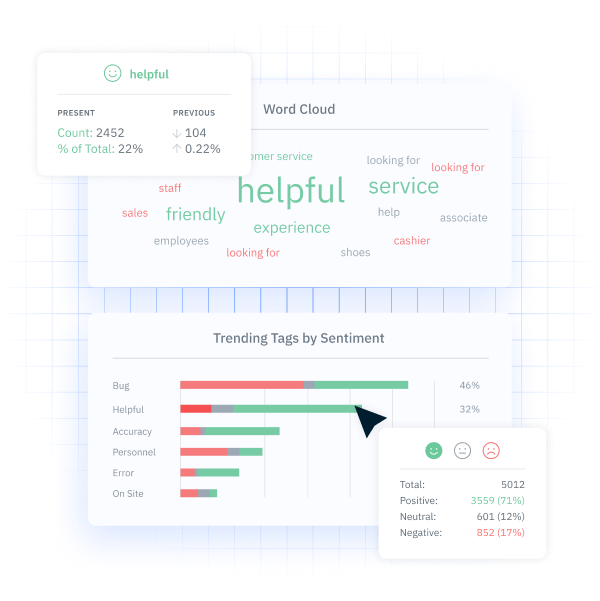
Text analysis, specifically text analysis software, is a method of analyzing customer feedback that involves using natural language processing (NLP) to extract insights from text data. If a business sends out a survey that includes open-response questions, it may want to use text analysis to identify common themes, sentiments, and topics in customer responses.

Customer Experience Metrics

Many forms of customer feedback offer numbers and ratings that make up customer experience metrics. These metrics are measures used to track the overall satisfaction of customers. The most common customer experience metrics include the Net Promoter Score (NPS), Customer Satisfaction Score (CSAT), and Customer Effort Score (CES). 

  • Net Promoter Score: The NPS is one of the most straightforward metrics that measures how likely a customer is to recommend the brand to their friends and family. It is usually gathered by asking customers to rate their willingness to recommend the product or service on a scale of one to ten.
  • Customer Satisfaction Score: CSAT is also relatively straightforward and measures how happy customers are with the product or service they received. Customers rate their satisfaction with the product or service on a scale of one to five.
  • Customer Effort Score: A CES uses a scale from one to seven to determine how easy customers feel it is to interact with the company and use its products or services. 

Customer Journey Mapping 

The process of customer journey mapping can be a great way to analyze feedback at different touchpoints in the customer journey to identify potential bottlenecks and opportunities for improvement. If a retail business is getting a lot of feedback about poor customer service, customer journey mapping would help them find out if this is happening in-store, or in the post-purchase phase. 

How to Develop A Customer Feedback Strategy

A customer feedback strategy works as part of the customer feedback loop. Your customer feedback strategy will be a detailed plan of how your business will go about collecting feedback from your customers, as well as how that feedback is implemented into the business. 

1. Define Your Objectives

To develop an effective customer feedback strategy, you need to have a clear idea of what you want to achieve. It is important to start by defining your main objectives. Whether you want to improve customer retention, make product or service improvements, or identify new opportunities, these goals will help you keep a clear purpose when collecting feedback. 

2. Identify Feedback Channels

Next, determine which feedback channels make the most sense for your business. These channels should represent the most common ways your customers communicate with you, and where you will have the biggest likelihood of hearing honest feedback. For example, a restaurant may choose to focus on the feedback received from post-transactional email surveys, while an e-commerce business may focus more on online reviews and social media posts. These channels cover areas where each respective business is most likely to hear from and communicate with their customer. 

3. Design Effective Feedback Tools 

Once your feedback channels have been selected, you need to focus on survey design. Ensure your surveys and questionnaires are concise and focused on specific aspects of the customer experience. When designing your feedback tools, it is useful to have a mix of qualitative and quantitative questions, such as rating scales combined with an open-ended question, to get a holistic view of the customer experience.

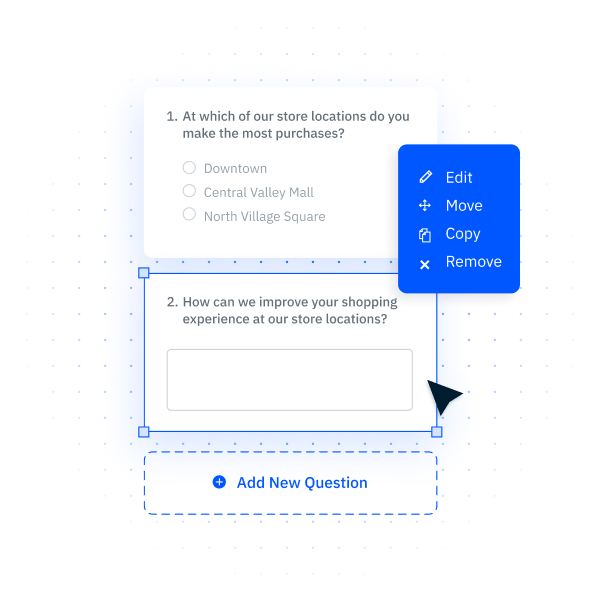
Screen capture of survey design software where the user can choose the types of and order of the questions.

4. Implement a Feedback Collection System

Choose the right tools and platforms to collect and manage feedback efficiently. You can use tools such as reputation management software to help streamline the feedback collection process. Regardless of the feedback collection system you use, remember that the most successful feedback methods are ones that can aggregate feedback from multiple sources in one place. 

5. Analyze the Feedback

After the feedback is collected, it is time time to analyze what your customers have said. Arguably the most important step in the entire process, this allows you to identify patterns and trends that will lead to actions that will have a positive impact on your business. When analyzing the feedback, use techniques such as sentiment analysis to gauge customer emotions and categorize feedback to pinpoint specific areas of concern or opportunity. Your customers’ feedback is not something that is only analyzed once, it will change over time and will constantly need to be monitored. Be sure to have resources in place that can continuously keep up with what your customers are saying. 

6. Close the Feedback Loop

Closing the customer feedback loop involves responding to customer feedback and making necessary changes based on the insights gathered. Knowing how to respond to reviews will help you communicate to your customers that their feedback has been received and is valued. This step also involves outlining to the customer how their feedback is being implemented and following up with them to make sure they are satisfied. 

7. Prioritize Business Actions

When your customer or client feedback has been received and analyzed, you may end up with a lot of actions that need to be taken to achieve your previously established goal. List all of the actions you could take, and prioritize them based on the impact on customer satisfaction, the feasibility of implementation, and alignment with business goals. There needs to be a balance of quick wins that will drive immediate success as well as long-term strategic initiatives. 

8. Monitor and Measure Results

At the beginning of developing your customer feedback strategy, you should have picked an objective or metric that you were going to measure. After customer feedback has been collected, analyzed, and implemented, it is now time to measure the results against your chosen objective to benchmark performance. As changes are continuously implemented, these metrics need to be regularly assessed to measure the impact of your strategy. 

It is possible that you may not see the results you were hoping for, in which case your strategy might need to be updated. This may look like changing your feedback collection methods, your survey design, or the objective you are focused on. 

9. Foster a Culture of Continuous Improvement

Customer feedback is most effectively collected and implemented when there is a company-wide culture that values it. Ensure all team members understand the importance of feedback and are equipped to contribute to the feedback process. Furthermore, be sure to celebrate the success of your customer feedback initiatives. Whether it is recognizing an employee mentioned in an online review, or a store location that realized increased customer satisfaction. Making all employees feel a part of the customer feedback process will ensure increased participation and success. 

10. Iterate and Adapt

Regardless of your business or industry, customer needs and market conditions are always evolving. To make sure your business does not fall behind, it is important to regularly revisit and refine your customer feedback strategy. Be willing to implement any new feedback channels, tools, or methodologies as you see fit to ensure the continuous success of your customer feedback program. 

Best Practices for Collecting Customer Feedback 

Collecting customer feedback effectively is crucial for gaining valuable insights that can drive improvements and enhance customer satisfaction. Here are some best practices to ensure you gather meaningful and actionable feedback: 

Ensure Anonymity

In some forms of feedback, such as online reviews or social media posts, the customer chooses to let themselves be identified. However, in other forms of feedback, such as email surveys, remaining anonymous is important to the customer and allows them to provide honest and complete feedback. Assure customers that their feedback will be confidential and used solely for improvement purposes.

Focus on Timing 

Timing is one of the most critical factors in collecting customer or client feedback. It is best to ask for feedback soon after a customer interaction, such as a purchase or product delivery, while the interaction or experience is fresh in their mind. For feedback that isn’t necessarily based on a recent customer interaction, such as a biannual customer satisfaction survey, it is best to send the survey at a time when your customers will have time to respond. 

Thank Customers for Their Feedback

Businesses should also thank customers for their feedback and express appreciation. This can help build customer loyalty and foster long-term relationships with customers. Additionally, repeat customers are more likely to provide honest feedback in the future if they feel that their responses are valued and used to make improvements. 

Collect Customer Feedback with InMoment

InMoment’s XI Platform gives you the tools to gather and analyze customer feedback in whatever way works best for your business. InMoment’s tools enable you to stay ahead of your competitors and deliver exceptional customer experiences. Schedule a demo today to see what InMoment can do for you. 

Speech Analytics: Turning Conversations into Actionable Insights

Speech analytics encompasses the transformation and analysis of audio recordings into text. This analysis provides businesses with key consumer insights, such as emotional tags and trending complaints. It can be used by businesses to understand the customer experience and make business improvements.
InMoment Contact Center intelligence solution for faster action and better insights

Speech analytics is quickly becoming a foundational aspect of successful experience improvement programs. Historically, it has been difficult to quantify metrics from customer calls. However, the rise of speech analytics has given businesses to understand their customers like never before. 

What is Speech Analytics?

Speech analytics is the process of analyzing recorded calls to gather customer information to improve communication and future interaction. It uses advanced technology to transcribe and analyze audio recordings. In doing so, speech analytics gives businesses the ability to uncover insights into customer behavior, sentiment, and preferences. This allows companies to enhance their customer service, marketing strategies, and overall operational efficiency. 

What is Contact Center Speech Analytics?

Contact center speech analytics specifically refers to the application of speech analytics technology in a call center environment. Usually working as part of contact center solutions, it involves analyzing the vast volumes of calls handled by contact centers to extract actionable insights from audio recordings. 

Contact center speech analytics is useful for businesses looking to improve their contact center performance and overall customer experience. The insights from recorded calls help identify common issues and train agents, which helps improve key customer experience metrics. 

By leveraging this technology, contact centers can turn every customer interaction into a valuable data point that drives continuous improvement.

How Does Speech Analytics Work?

Speech analytics combines several advanced technologies to analyze spoken language. The process involves multiple steps:

  • Capturing Audio: The first step is recording conversations between customers and agents. These recordings are stored for analysis.
  • Automatic Speech Recognition (ASR): ASR technology converts spoken words into text. This is a crucial step as it translates the audio data into a format that can be analyzed.
  • Natural Language Processing (NLP): Natural language processing algorithms process the transcribed text to understand the context, sentiment, and meaning behind the words. This involves parsing the text and identifying keywords, phrases, and patterns.
  • Machine Learning: Machine learning models analyze the processed text to extract insights. These models can identify trends, detect anomalies, and predict outcomes based on historical data.
  • Share Insights: The final step is generating reports and dashboards that present the insights in an easily digestible manner. These insights can be shared with managers, executives, or other stakeholders in order to make informed decisions. 

Why is Speech Analytics Important?

Speech analytics is important because it gives you a way of understanding your customers that may not have been previously accessible. A recent study showed that 86% of consumers preferred to talk to a real agent rather than a chatbot or AI-based system regarding customer service inquiries. If you did not have speech analytics software, the only way you would be able to identify common themes and trends is to manually listen to recordings. This is a costly and time-consuming process. 

With speech analytics and speech analytics software, you are still able to provide the consumer with the experience they are looking for, while also getting the analysis and data that is important to your business. 

What are the Benefits of Speech Analytics?

The benefits of speech analytics extend beyond just sentiment analysis. These tools can help you train employees, develop marketing campaigns, and invest in business improvement that will make an immediate impact. Here are some common benefits of utilizing speech analytics:

Improved Agent Performance

Speech analytics can be a tool to help benchmark agent performance. The insights from speech analytics can help identify the strengths and weaknesses of agents. Businesses can identify best practices to be taught in onboarding and training sessions by analyzing interactions with multiple agents.

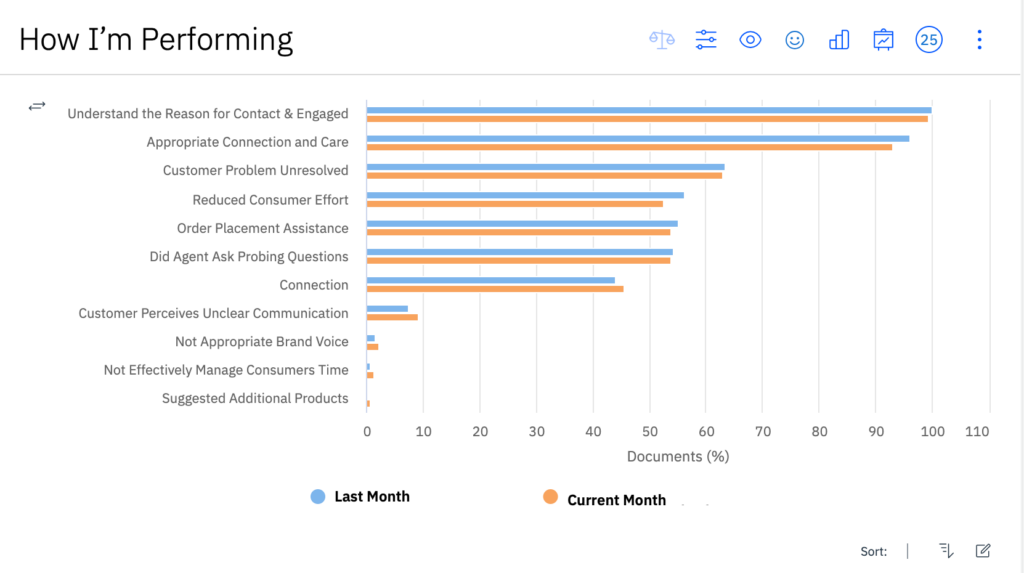
A dashboard showing a call center agent's performance in the current month comapred to the previous month.

Enhanced Customer Understanding

By utilizing speech analytics software, businesses can gain a deeper understanding of their customers by analyzing the context and content of their conversations. They have the ability to view a conversation in its entirety and identify specific emotional tags that arose throughout the course of the case. Identifying these themes will help companies meet customer expectations, which will lead to increased customer satisfaction and loyalty. 

Real-time Problem Resolution

With real-time speech analytics, businesses can detect and address issues as they occur during customer interactions. This immediate insight allows supervisors to intervene when necessary, preventing escalation and improving the chances of resolving issues on the first call. Real-time analytics also helps in managing high-stress situations and ensuring that customer concerns are addressed promptly and effectively.

Speech Analytics Uses Cases & Examples

The applications of speech analytics are not limited to one industry or use case. This form of analytics has a wide range of capabilities that can be used from healthcare to e-commerce.  The following examples highlight different speech analytics use cases

Speech Analytics in Healthcare

Consider a large healthcare contact center that handles patient inquiries, appointment scheduling, prescription refills, and other services. The nature of this contact center means that they handle thousands of calls daily, and manually listening to the recordings would be an ineffective use of time. 

By implementing speech analytics software, all incoming and outgoing calls can be recorded and stored securely in compliance with HIPAA regulations. These calls are transcribed into text, analyzed, and categorized by common tags such as calls related to appointments, billing, or prescription refills. 

After the calls are categorized, the trends can be analyzed. Perhaps this call center notices that over the last 90 days, there has been an increase in calls related to long wait times. These insights are shared with hospital management, which may result in an increase in staffing during certain hours to decrease wait times. By utilizing speech analytics, this healthcare organization was able to increase patient satisfaction. 

Speech Analytics in E-Commerce

Imagine an e-commerce company that operates an omnichannel contact center. This contact center handles customer inquiries across multiple channels such as phone, email, online chat, and even review management. This contact center may already have a text analytics solution in place to tag and categorize customer feedback in the form of text data. However, being unable to effectively tag customer calls, these are left out of the data. This leads to an incomplete picture of the e-commerce customer experience. 

By implementing speech analytics, customer calls can be recorded in a way that allows them to be added to the rest of the contact center customer data. This provides the business with a complete view of its customer experience and helps identify areas of improvement. 

What is Next For Speech Analytics?

While speech analytics is not necessarily in its infancy, it has been no stranger to increased growth. The future of speech analytics is closely tied to advancements in AI and machine learning. These AI algorithms will enable better detection of emotions and sentiments. You can expect speech analytics to improve in two major ways in the coming future: 

AI Speech Analytics

AI speech analytics can be used as another way to describe the current capabilities of speech analytics because of the use of machine learning. However, AI speech analytics will continue to grow by going beyond just categorizing audio recordings. After identifying different emotional tags and trends, AI speech analytics will be able to quickly summarize the findings and offer immediate areas for improvement. This, as opposed to presenting the data and requiring human input, will make the end-to-end process of speech analytics quicker. 

Of course, as these capabilities grow, there will be errors, and all important data and decisions should be human-reviewed. That being said, the continued growth of speech analytics will most likely result in the further optimization and improvement of businesses. 

Holistic Analytics

Holistic analytics represents the combination of speech analytics, text analytics, and video analytics. Putting these solutions together will make it easier for organizations to understand their customers, regardless of the channel they choose to communicate with them from. Also, as a packaged deal, it will be more cost-effective and most likely provide a better return on investment. 

What to Look For in Speech Analytics Software

Not all speech analytics software comes with the same features. The features that are the most important will depend on the specific goals of your business. However, there are certain features that should be must-haves when looking for a speech analytics solution. 

Diverse Analysis Capabilities

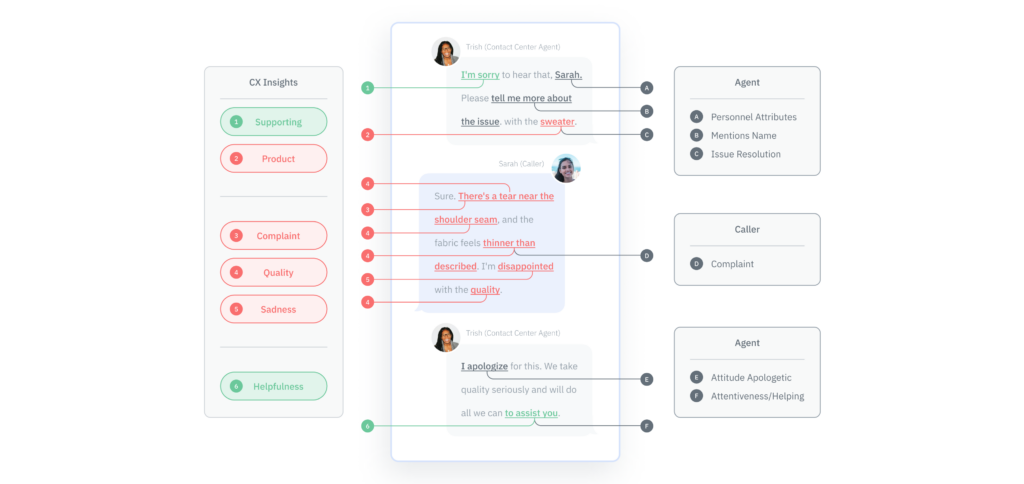
While some businesses may settle for a speech analytics solution that is limited to only analyzing the customer during the call. Advanced speech analytics solutions will have a wide range of analysis capabilities that are able to analyze customer emotions as well as how the agent is responding to the customer and how the two parties interact. By analyzing the conversation in its entirety, you gain access to a more complete analysis. 

A conversation between a contact center agent and a customer, where AI speech analytics has highlighted customer sentiment.

Integration Capabilities 

It is important to choose a solution that supports a wide range of integrations, such as integrating into your contact center analytics software. Being able to implement speech analytics software that works alongside your current systems will increase the adoption rate within the organization and get the most out of the software as soon as possible. 

Support

It is important to choose speech analytics software that comes with a dedicated support team. This is important because having expert support ensures that any issues or challenges are promptly addressed. 

Best Practices for Implementing Speech Analytics Software

In order to complete a smooth implementation of speech analytics software, it is best to have a plan. Having an implementation plan will make sure the organization can succeed with the software, and get all appropriate staff involved in the right order. 

1. Define Objectives

By defining your objectives, you clearly outline what you are aiming to achieve. This will help you stay focused and avoid any distractions that come up in the early stages of adoption. For example, you may be tempted to set up a feature you did not fully understand in the demo. But, doing so wouldn’t allow your team to use the core functionalities they need. By having a goal, you can make sure your team has what they need as soon as possible. 

2. Integrate with Existing Systems

During the implementation process, it is vital to ensure that the software works well within your current technology stack. If there is an issue, contact your support team as soon as possible to try and get the issue resolved. 

3. Train Employees

As soon as the software is accessible to all employees, provide comprehensive training on how to use the software and interpret its insights. This step is crucial to the adoption across the company. Avoiding this will cause employees to make mistakes, which may take more time to resolve. 

4. Monitor

After the initial implementation push is over, monitoring the chosen software is important to its continued success. As it becomes a more integral part of your business processes, certain discrepancies may arise that need to be addressed. Conversely, all early successes with the software need to be highlighted so they can be recreated in the future. 

Choose InMoment as Your Speech Analytics Solution

InMoment’s conversation analytics software allows your business to have access to state-of-the-art speech analytics software, as well as other capabilities such as AI summarization, agent and coach scorecards, and more! See what InMoment can do for you by scheduling a demo today. 

References 

CGS. CGS Survey Reveals Consumers Prefer a Hybrid AI/Human Approach to Customer Service. Is there Chatbot Fatigue? (https://www.cgsinc.com/en/resources/2019-cgs-customer-service-chatbots-channels-survey). Accessed 6/27/2024.

REPORT

InMoment Named a Leader in The Forrester Wave™: Text Mining And Analytics Platforms, Q2 2024

Learn how InMoment is pioneering innovative solutions for businesses to extract insights and drive meaningful change from their unstructured text data.

Get the Report

A group of four business people having a discussion around a table

With the increased adoption of AI in business across all industries, there has also been a rise in text mining and analytics. This software, which exists as an extension of AI and natural language processing (NLP), is used to gather insights from unstructured text data in order to make informed business decisions. 

If your business has reached the need to purchase text analysis software, you are more than likely comparing third-party evaluations as part of your research process. Understanding these third-party evaluations is crucial to choosing the right software for your business. Among these evaluation tools are evaluative Analyst reports such as The Forrester Wave, Gartner Magic Quadrant, or IDC MarketScape

The Forrester Wave™ is a valuable resource that evaluates and ranks vendors in a particular market, but understanding how to read and interpret the Wave report can be daunting. By reading this guide, you will understand how to navigate reports like the Forrester Wave and make informed decisions from the reports’ implications. 

What is the Difference Between Gartner and Forrester?

The Forrester Wave™ and the Gartner Magic Quadrant™ are widely recognized and influential market research reports evaluating technology vendors. While both serve to help buyers make informed decisions, they differ in methodology, structure, and focus.

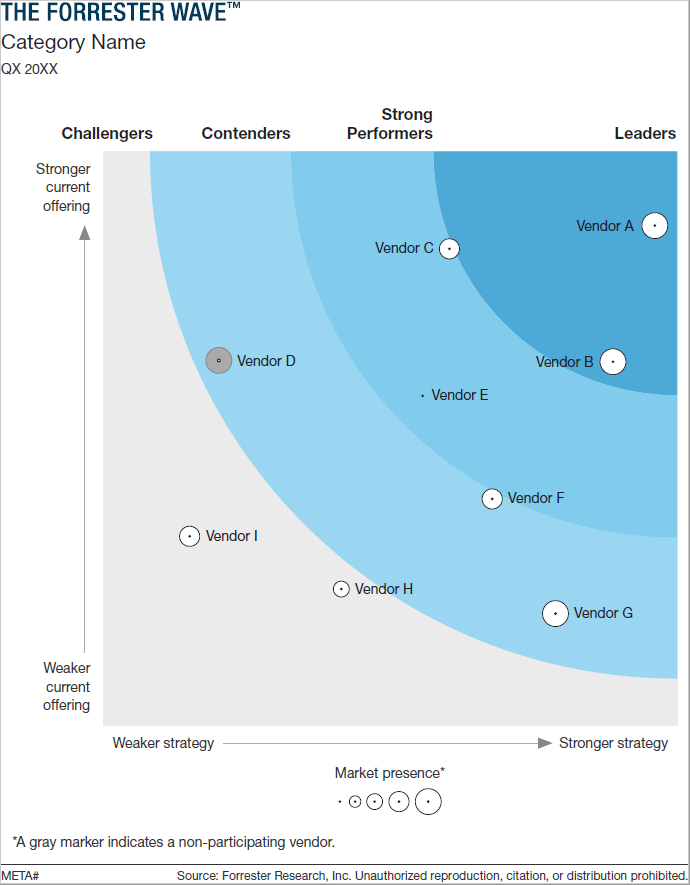
In the Forrester Wave, vendors are ranked based on criteria such as their strategy and current offering, which represent the x and y axes. They are also ranked on market presence, which is represented by the size of the dot on the graphic. For each of these three categories, there are subcategories that vendors are scored on. These scores are taken into account and then vendors are positioned in segments such as Leaders, Strong Performers, Contenders, and Challengers on the Wave graphic. 

Conversely, the Gartner Magic Quadrant™ offers a high-level overview, evaluating vendors based on their Completeness of Vision and Ability to Execute. Vendors are placed in one of four quadrants: Leaders, Challengers, Visionaries, and Niche Players. The Magic Quadrant is useful for quickly comparing vendors and understanding the overall market landscape and strategic positioning.

Ultimately, the Forrester Wave™ is best for buyers seeking a detailed, customizable evaluation, while the Gartner Magic Quadrant™ is suited for those needing a quick, strategic overview of vendor capabilities and market trends. Understanding these differences helps buyers select the right tool for their specific needs.

Understanding the Forrester Wave™ Methodology

The Forrester Wave™ is a comprehensive evaluation of technology providers in a specific market. For text analytics, it assesses vendors based on a detailed set of criteria to provide a comparative analysis. Here’s how it works:

  1. Vendor Selection: Forrester selects the most significant vendors from the preceding Landscape report which acts as a precursor to the evaluative Wave and outlines market dynamics, top business use cases, and provides a list of ‘players’
  2. Criteria and Weightings: Forrester defines a set of criteria that comprise the two categories of strategy and current product offering. Weightings of these criteria (how much each one is worth) are not shared with vendors until post-publication… Each criterion is assigned a weight based on its importance to the overall evaluation.
  3. Data Collection:There are three inputs into a Forrester Wave evaluation: a questionnaire, a strategy and product demo session, and customer references.
  4. Scoring: Each vendor is scored on a scale (0 to 5) for each criterion. These scores are then weighted and combined to produce an overall score for each category.
  5. Wave Graphic: The scores are plotted on a wave graphic, with vendors positioned in different segments: Leaders, Strong Performers, Contenders, and Challengers. The size of the dots are representative of the vendors’ market presence, which is determined by revenue. 

Decoding Forrester Wave™ Classifications

The Forrester Wave graphic visually represents the relative strengths and weaknesses of each vendor. Here’s what the graphic for each Wave looks like as well as what each classification means:

An example of the Forrester Wave graphic showing how vendors are represented.
  • Leaders: These vendors have the highest scores in the evaluation criteria. They exhibit strong current offerings, robust strategies, and a significant market presence. Leaders are generally the safest choice for most buyers.
  • Strong Performers: Vendors in this segment have solid offerings and strategies but may lack in some areas compared to leaders. They are still viable options, especially if they meet specific needs or have unique strengths.
  • Contenders: These vendors may have competitive offerings but are often limited by weaker strategies or lower market presence. They can be suitable for buyers with specific requirements that align with the vendor’s strengths.
  • Challengers: Vendors in this category typically have lower scores across multiple criteria. They may be newer to the market or lack certain features. They are riskier choices but might offer innovative solutions or cost advantages.

Key Components of the Forrester Wave for Text Analytics

The full Forrester Wave report will consist of three main sections: current offering, strategy, and market presence. Each category will cover different aspects of an organization’s presence in the marketplace. 

Current Offering: This category evaluates the product’s features and capabilities. Key criteria might include:

  • AI: ML-based, knowledge-based, or symbolic
  • Generative AI: Pre and post-processing 
  • Deployment options
  • Omnichannel data integration
  • Security and regulatory compliance 

Strategy: This category assesses the vendor’s vision and roadmap. Key criteria might include:

  • Innovation: The vendor’s commitment to innovation and staying ahead of market trends.
  • Product Roadmap: The planned future developments and improvements.
  • Pricing flexibility and transparency

What This Means for Buyers

As a buyer, the Forrester Wave for Text Analytics provides a comprehensive and unbiased assessment of the market. Here’s how you can use it:

  1. Identify Your Needs: Determine what’s most important for your organization. Are you looking for a platform with advanced NLP capabilities? Or is integration with existing systems more critical?
  2. Compare Vendors: Use the Wave graphic to compare vendors at a glance. Focus on the Leaders for well-rounded options, but don’t overlook Strong Performers if they align better with your specific needs.
  3. Dive Deeper: Read the detailed vendor profiles and scores for a deeper understanding of each vendor’s strengths and weaknesses. Pay attention to how vendors perform in areas that matter most to your organization.
  4. Evaluate Market Trends: Consider the market trends and how vendors plan to adapt to them. For example, vendors will no longer differentiate themselves on text mining functionality alone, it is the pre and post-processing processes that will set them apart. 
  5. Consider Future Needs: Look at the strategy scores and product roadmaps to ensure the platform you choose will continue to meet your needs as your organization grows and evolves.

InMoment’s Placement in the Forrester Wave

InMoment was recently recognized as a Leader in the Forrester Text Mining & Analytics Wave ‘24. This achievement highlights the capabilities of the XI Platform such as knowledge-based AI, document-level text mining, natural language understanding, and more!

To learn more about InMoment’s platform, schedule a demo today! 

a woman at a counter in a retail shop smiling at someone else

The ability to track customer happiness with one number can almost sound too good to be true. However, the CSAT score is used by businesses across the world to track their customers’ happiness and make strategic decisions.

What Does CSAT Stand For?

Customer Satisfaction score, commonly referred to as CSAT, is an attempt at capturing how satisfied customers are with a company’s goods and services. A survey asks a customer to rate their satisfaction, typically on a scale from 1 to 5.

Why CSAT Is Important

What’s most important about customer experience metrics such as NPS, CES, and CSAT is their predictive power. While financial metrics are past indicators of a company’s performance, customer satisfaction metrics are leading indicators. After all, if your customers are not happy with what you have to offer today, one can predict it will reflect in the financial statements later in the form of churn, decreasing share of wallet, etc.

Knowing and monitoring your company’s CSAT score is one reason to implement a CSAT program. The score can be segmented, benchmarked, and tracked over time. More importantly, setting up a CSAT program is an opportunity for a systematic solicitation and collection of actual customer feedback that can be used across the organization for continuous improvement. Product teams can use it to plan their product roadmap. Account executives who become aware of problems with one client can remedy, or conversely, fully realize the value another customer is getting from the product, price accordingly, or cross-sell; engineering teams can design better products, and fix problems if they have access to that feedback, and service teams can improve on the service they provide.

In brief, CSAT is an easy to understand metric, versatile enough that it can be used in many scenarios and touchpoints–and low CSAT can predict churn.

How to Measure Customer Satisfaction?

Measuring Customer Satisfaction is done through surveys. It sounds simple and straightforward enough, however getting to an accurate number involves some statistical science.The main question asked in the customer satisfaction survey is how satisfied are they with the business or product, along with a rating scale.

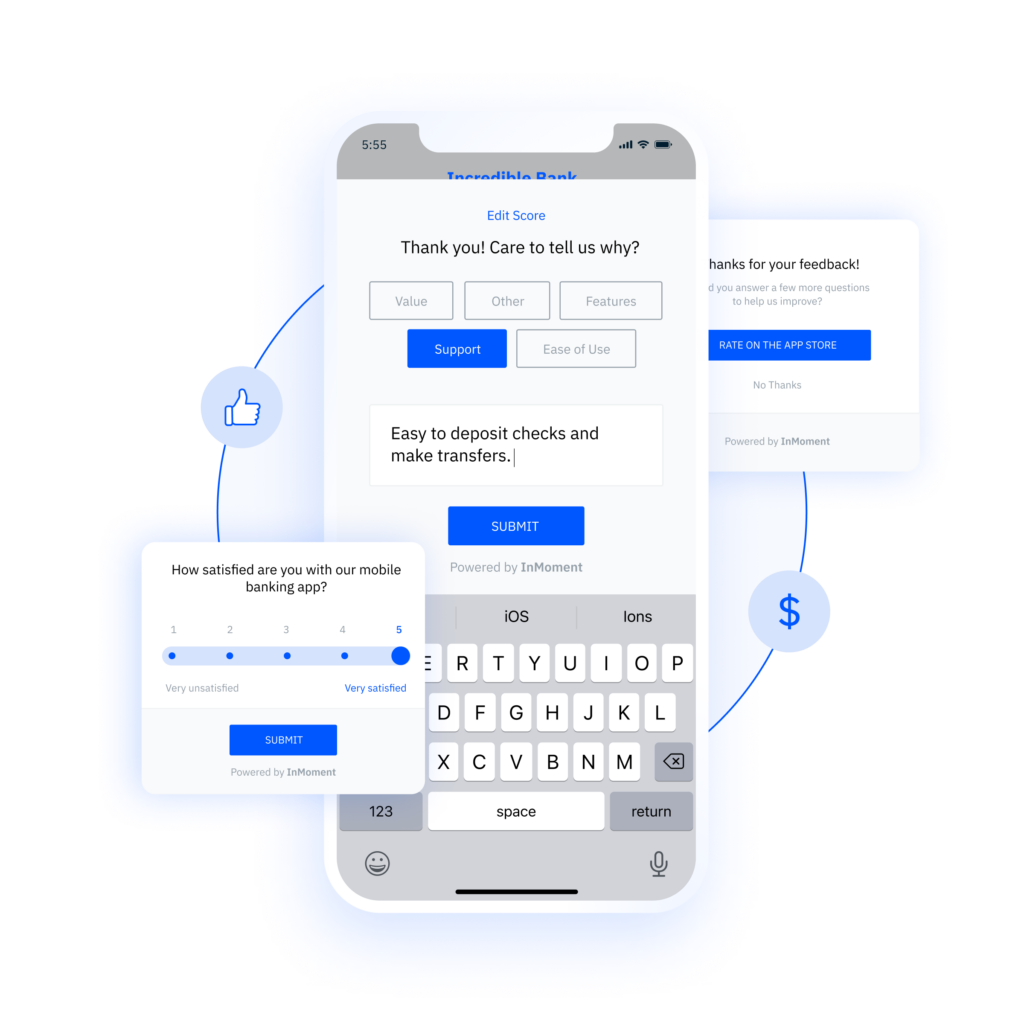
An example of a CSAT survey. The heading reads "How satisfied are you with SaaSy.co?" And there is a scale from 1-5 below it.

The most common customer survey questions all have different rating scales which can become easily confusing: the CSAT is a simple 1 to 5, the Customer Effort Score (CES) question is from 1 to 7, and the NPS question is from 1 to 10. In the end, the scale does not quite matter as much and some organizations create their own custom metrics. However, having a standard helps professionals have a consistent frame of reference when measuring customer satisfaction against CSAT, NPS, and CES.

How to Calculate CSAT Score?

Calculating the CSAT score involves interpreting the responses gathered from a standardized CSAT survey. Below are the steps to determine the CSAT score:

1. Choose a Scale:

CSAT surveys typically use a scale, commonly ranging from 1 to 5 or 1 to 10, with higher values indicating greater satisfaction. Ensure that the scale used in your survey is clearly communicated to respondents.

2. Collect Survey Responses:

Gather responses from your CSAT survey. Each respondent will provide a numerical rating based on their satisfaction level.

3. Count Positive Responses:

Identify the number of positive responses, typically represented by the highest rating on your scale. For example, if you are using a 1 to 5 scale, responses of 4 and 5 are considered positive.

4. Total Number of Responses:

Determine the total number of survey responses received. This is the sum of positive and non-positive (neutral or negative) responses.

5. Calculate CSAT Score:

Use the formula below to calculate the CSAT score as a percentage:

CSAT Score = (Number of Positive Responses/Total Number of Responses)×100

For example, if you had 20 responses and out of the 20 there were only 8 that rated your business or product a 4 or a 5. Then you would take 8 divided by 20 and multiply that by 100, your CSAT score would be 40%.

What is a Good CSAT Score? 

Customer Satisfaction (CSAT) scores play a pivotal role in understanding how well a business meets its customers’ expectations. Determining what constitutes a “good” CSAT score is not a one-size-fits-all endeavor; it involves considering various factors specific to the industry, company goals, and customer base.

1. Benchmarking for Context:

CSAT scores gain significance when viewed in the context of industry benchmarks. Industry standards and best practices can serve as a yardstick for what is considered a good CSAT score. These benchmarks provide a reference point for businesses to gauge their performance relative to competitors or similar service providers. A good CSAT score should not only meet industry standards but ideally surpass them.

For example, the American Customer Satisfaction Index reported that full-service restaurants had an average score of 81 in 2023. Finding the average score in your industry will be an important metric on which to compare your organization’s customer satisfaction performance. As a general rule, here are the overall statistics regarding CSAT scores:

  • A CSAT score of 80% and above is generally considered excellent.
  • Scores between 70% and 79% are considered good.
  • Scores between 50% and 69% may indicate room for improvement.
  • Scores below 50% may signal significant issues requiring urgent attention.

2. Interpreting the Scale:

The scale used to measure CSAT scores varies across businesses, commonly ranging from 1 to 5, 1 to 10, or 1 to 100. Understanding the nuances of the scale is crucial; what might be considered a good score on a 1 to 5 scale may differ from what’s considered good on a 1 to 10 scale.

3. Aligning with Customer Expectations:

The essence of customer satisfaction lies in meeting or exceeding customer expectations. A good CSAT score reflects a positive alignment with the expectations of your specific customer base. Knowing your customers and their needs is necessary for interpreting the significance of your CSAT scores.

4. Consistency Over Time:

It is essential to monitor the trend of CSAT scores over time. A consistent upward trend suggests improving customer satisfaction, while a decline may signal the need for closer attention to customer concerns.

5. Qualitative Feedback Analysis:

Numbers only tell part of the story. Beyond the numerical score, businesses should delve into the qualitative feedback provided by customers. Understanding the reasons behind the scores provides valuable insights into areas that require improvement.

The Advantages and Disadvantages of CSAT

While the CSAT score is a valuable tool for measuring customer satisfaction and can provide actionable insights for improving customer experience, it should be used in conjunction with other feedback mechanisms to ensure a holistic understanding of customer sentiment

Balancing the simplicity and immediacy of CSAT with deeper, more comprehensive feedback methods can help businesses achieve a more accurate and effective approach to customer satisfaction. Regardless, the CSAT score is very useful and comes with its own set of pros and cons. 

Advantages of CSAT

  • Simplicity and Ease of Implementation: CSAT surveys are straightforward to create and administer. They typically consist of a few questions that can be quickly answered by customers, making it easy to gather feedback without overwhelming them.
  • Immediate Feedback: CSAT surveys are often conducted immediately after an interaction or transaction, providing timely insights into customer satisfaction. This allows businesses to quickly address any issues and improve their services.
  • Quantifiable Results: The results from CSAT surveys are easy to quantify and analyze. Businesses can track changes in satisfaction over time and identify trends, making it easier to measure the impact of any changes implemented.
  • Actionable Insights: Since CSAT surveys focus on specific interactions or transactions, the feedback is often highly relevant and actionable. Businesses can use this information to make targeted improvements in their customer service or product offerings.
  • Benchmarking: CSAT scores can be benchmarked against industry standards or competitors, providing a clear picture of where a business stands in terms of customer satisfaction. This can be a valuable tool for strategic planning and competitive analysis.

Disadvantages of CSAT

  • Limited Scope: CSAT surveys typically focus on recent interactions and may not capture the overall customer experience or long-term satisfaction. This can result in a narrow view of customer sentiment.
  • Subjectivity: Customer satisfaction is inherently subjective, and responses can be influenced by factors outside of the business’s control, such as the customer’s mood or external circumstances. This can sometimes lead to skewed results.
  • Lack of Depth: While CSAT surveys are great for capturing immediate feedback, they often lack the depth needed to fully understand the reasons behind customer dissatisfaction. Additional qualitative methods may be necessary to gain a complete understanding.
  • Survey Fatigue: Frequent CSAT surveys can lead to survey fatigue, where customers become less likely to respond or provide thoughtful feedback. This can reduce the effectiveness of the survey and the quality of the data collected.
  • Overemphasis on Scores: Relying too heavily on CSAT scores can lead businesses to focus on improving the score itself rather than addressing the underlying issues that impact customer satisfaction. It’s important to use CSAT as one of many tools in a comprehensive customer feedback strategy.

Why Sample Size Is Important When Measuring Customer Satisfaction

Another consideration in measuring customer satisfaction is how many surveys need to be sent out, and how many responses need to be received to obtain a reliable score? If you’ve ever taken a statistics class, you might remember that the survey sample size n to reach is:

n = (z*𝜎/𝜀)^2

Where 𝜀 is the margin of error, z is the z-score for a given confidence level and 𝜎 the standard deviation.

Interestingly, the number of survey responses you’d have to reach does not depend on how many customers you have in the first place. More customers do not mean you have to poll more of them. How many customers you need to poll has more to do with how much variance (standard deviation 𝜎 is the square root of the variance) there is in between their answers to the CSAT question. It somewhat intuitively makes sense. If the first responses that come in are all 4’s and 5’s, you’ll expect future responses to be in the same ballpark. If you sometimes get 1s, sometimes 4s, you’ll want to continue polling to narrow in on a score. In summary, when measuring customer satisfaction, variability requires larger samples.

The second factor that impacts sample size is the margin of error. For a CSAT scale of 1 to 5, let’s say you’d be comfortable with +/- 0.5 points from the mean, a 10% margin of error.

Taking a common 95% confidence interval, z = 1.96, and let’s say a previous survey showed a 1.4 point standard deviation, then the sample size would be n = (1.96*(1.4/0.5))^2 = 30 responses. Now, if a margin of error of +/- 0.25 points was required, it would drive up the sample size to 120.

The Type of Survey Matters When You Measure Customer Satisfaction

The old-fashioned way for a company to measure customer satisfaction would be to mass email, and/or direct mail a subset of customers twice a year. They’d use a formula like this one to calculate the sample size needed to reach statistical significance. 

However, by the time the survey is conducted and results compiled, the company’s products, services, and processes will have evolved a bit, and the CSAT score would already be obsolete. And closing the loop on any negative feedback would be less than timely and not as effective in reducing customer churn

Finally, email or direct mail could be two useful types of surveys if that is the best way to engage with your customers, but often requires higher samples given the low response rates of those channels.

Measuring Customer Satisfaction in a Timely Way

The demand for more accurate and timely customer insights has created a niche for software vendors to develop tools that can handle the surveying, the sampling, computation, and measuring of standard customer experience metrics such as CSAT, CES, and NPS. As more and more companies have moved their products and services online, some of these vendors offer the ability to survey customers directly during the customer’s web or mobile experience. Measuring customer satisfaction about their experience right as they’re engaging with the brand at key journey points generates more contextual feedback and a chance to remediate.

Measuring customer satisfaction twice a year is not enough to manage a business proactively. Tools are now available to get a real-time CSAT for anyone in the company to see and rally around.

Customer Satisfaction Use Cases

By far, the most common use case of CSAT is as a departmental metric in managing contact centers, with customer service and support teams. A CSAT survey is triggered after an interaction with a support or service representative or agent. Modern CSAT tools will have an integration with common helpdesk and CRM software so that the survey can get triggered upon a case closure or issue resolution. These departments might track other metrics: the volume of low CSAT ratings (3 or lower) (if the survey is triggered after each interaction), or the time it took to respond to the opening of an issue, and the percentage of issues successfully resolved.

Product teams also use CSAT to understand what makes the customer tick, or where the product might fall short. They might have heard anecdotes and qualitative feedback from front-line employees, but CSAT surveys are a great way for product teams to get access to first-hand feedback right at their fingertips.

How to Improve Customer Satisfaction

  • Start measuring. Invest in a survey tool that can quickly and simply get that CSAT metric right into your hands in real time, and provides the ability to track the metric over time.
  • Measure CSAT at various touchpoints along the buyer journey.
  • Tag issues as they come in. Some tools will have auto-tagging, and even natural language processing to interpret and classify the feedback.
  • Build a process to close the loop with customers in real time.
  • Take action. Route the issues, customer insights, and feedback themes to the appropriate teams for resolution.
  • Monitor CSAT trends, in aggregate, at various touchpoints, product lines, or any segments relevant to the business, and build a plan for making systemic change.

Focusing on efforts to improve your organization’s customer satisfaction can help you increase loyalty and even grow your bottom line. Check out the potential ROI your organization could see from investing in CX with our handy calculator!

Calculate your business’s ROI using InMoment’s VoC tools.

Estimated Revenue Growth
Use the calculator to find an estimated ROI
Total ICX ROI

Submit two or more calculators to show an overview of what your integrated CX program could return.

Improve Your Customer Satisfaction with InMoment

At InMoment, we specialize in survey software for customer experience. We have helped across multiple industries take the necessary steps to improve their customer satisfaction. Whether you’ve got 10 locations or 1000 locations, we can help you too. Schedule a demo today to see our platform in action!

Text Mining: Everything You Need to Know

Text mining is the process of extracting useful information from large amounts of text using computational techniques. It involves analyzing and transforming unstructured text into structured data for insights.
Two hands typing on a laptop

In today’s data-driven world, businesses generate and accumulate vast amounts of text data from various sources, including customer feedback, social media, emails, and internal documents. However, extracting meaningful insights from this unstructured data can be challenging. 

This is where text mining comes into play. By transforming unstructured text data into valuable information, text mining enables businesses to uncover hidden trends, sentiments, and relationships within the data. This process is crucial for making informed decisions, enhancing the customer experience, and maintaining a competitive edge. 

What is Text Mining?

Text mining, also known as text data mining, is the process of analyzing unstructured text data to extract meaningful patterns and insights. This process involves using techniques from natural language processing (NLP), machine learning, and statistics to transform textual information into a structured format that can be easily analyzed. By doing so, organizations can uncover hidden trends, sentiments, and relationships within the data, which can inform strategic decisions and drive business growth.

Text Mining Examples and Use Cases

Consider a business interested in contact center optimization. They could implement text mining to enhance operations and improve customer satisfaction. The center can identify common customer issues and frequently asked questions by analyzing transcripts of customer service calls, emails, and chat interactions.

From those insights, the contact center can pinpoint areas where agents need additional training and identity processes that require streamlining. For instance, text mining might reveal that a significant number of calls were related to the same few technical issues. This discovery can lead to bug fixes as well as a more comprehensive knowledge base for agents, which can significantly reduce call resolution times. 

Why is Text Mining Important?

In an era where data is considered the new oil, the ability to analyze and derive insights from unstructured text data is invaluable. Text mining is important for several reasons:

1. Extracting Valuable Insights: Text mining enables businesses to sift through large volumes of unstructured text data and extract valuable insights. Whether it’s customer feedback, social media comments, or internal documents, these insights can reveal trends, sentiments, and patterns that are crucial for strategic decision-making.

2. Enhancing Customer Experience: By analyzing customer feedback and sentiment, companies can better understand their customers’ needs, preferences, and pain points. This understanding allows businesses to tailor their products, services, and interactions to meet customer expectations, thereby enhancing overall customer satisfaction and loyalty.

3. Improving Operational Efficiency: Text mining can help identify inefficiencies and areas for improvement within an organization. For example, analyzing support tickets and emails can reveal common issues that need addressing, enabling companies to streamline their operations and improve service quality.

4. Supporting Data-Driven Decision Making: Text mining transforms unstructured data into structured data that can be easily analyzed and visualized. This transformation supports data-driven decision-making processes by providing actionable insights that are grounded in actual data rather than intuition or guesswork.

5. Gaining Competitive Advantage: By leveraging text mining, businesses can stay ahead of the competition by quickly identifying market trends, customer preferences, and emerging issues. This proactive approach allows companies to adapt and innovate faster than their competitors.

6. Enabling Predictive Analytics: Text mining can also be used in conjunction with predictive customer analytics to forecast future trends and behaviors. For instance, sentiment analysis of customer reviews can predict future product success, while topic modeling can identify emerging trends in customer interests.

Difference Between Text Mining and Text Analytics

While text mining and text analytics are often used interchangeably, they have distinct focuses and processes. Understanding the difference between the two can help businesses leverage the right techniques for their specific needs.

Text Mining

Text mining is the process of discovering patterns and extracting useful information from unstructured text data. It involves transforming text into a structured format, which can then be analyzed. The primary goal of text mining is to uncover hidden insights and trends that are not immediately obvious.

Key Components of Text Mining:

  • Data Collection: Gathering text data from various sources such as websites, social media, emails, and internal documents.
  • Preprocessing: Cleaning and preparing the text data by removing noise, normalizing text, and tokenizing.
  • Transformation: Converting text into a structured format using techniques like vectorization.
  • Analysis: Applying NLP, machine learning, and statistical methods to identify patterns and extract insights.

Text Analytics

Text analytics is the application of text mining techniques to solve specific business problems. It involves analyzing the structured data produced by text mining to gain actionable insights and inform decision-making. Text analytics often integrates text mining results with other types of data analysis to provide a comprehensive understanding of the data.

Key Components of Text Analytics:

  • Integration: Combining text data with other data sources to provide a holistic view.
  • Visualization: Presenting the findings in a comprehensible format using graphs, charts, and dashboards.
  • Reporting: Generating reports that highlight key insights and recommendations.
  • Actionable Insights: Using the analyzed data to inform business strategies and decisions.

Consider a company analyzing customer reviews to improve its products. Text mining would involve processing the reviews to identify common themes and sentiments. Text analytics would then take these findings and integrate them with sales data to understand the impact of customer feedback on product performance and make strategic recommendations.

How Text Mining Works

Text mining involves several steps that transform unstructured text data into structured data, which can then be analyzed to extract meaningful insights. Here is a detailed look at the key steps involved in the text mining process:

1. Data Collection: The first step in text mining is gathering text data from various sources. This can include customer feedback, social media posts, emails, online reviews, internal documents, and more. The data collection process may involve web scraping, database extraction, or API integration to aggregate the text data into a single repository.

2. Preprocessing: Once the data is collected, it needs to be cleaned and prepared for analysis. Preprocessing involves several sub-steps:

  • Tokenization: Splitting the text into individual words or tokens.
  • Stop Words Removal: Eliminating common words (e.g., “and”, “the”, “is”) that do not contribute to the analysis.
  • Stemming and Lemmatization: Reducing words to their root form (e.g., “running” to “run”).
  • Normalization: Converting text to a standard format, such as lowercase all words and removing punctuation and special characters.

3. Transformation: After preprocessing, the text needs to be transformed into a structured format. This often involves:

  • Vectorization: Converting text into numerical vectors that represent the frequency or presence of words or phrases. Common techniques include Term Frequency-Inverse Document Frequency (TF-IDF) and word embeddings like Word2Vec.
  • Feature Extraction: Identifying and extracting relevant features from the text that can be used in subsequent analysis.

4. Analysis: With the structured data in hand, various analytical techniques are applied to extract insights:

  • Natural Language Processing (NLP): Techniques such as named entity recognition (NER), part-of-speech tagging, and dependency parsing to understand the structure and meaning of the text.
  • Machine Learning: Applying algorithms to classify, cluster, and predict outcomes based on the text data. Common methods include sentiment analysis, topic modeling, and text classification.
  • Statistical Analysis: Using statistical methods to identify patterns, correlations, and trends within the text data.

5. Visualization: The final step is to present the findings in an easily understandable format. Visualization tools and techniques are used to create graphs, charts, word clouds, and dashboards that highlight key insights and trends. Effective visualization helps stakeholders quickly grasp the results and make informed decisions.

A compilation of images showing a word cloud and analysis produced from text mining

Text Mining Best Practices

Implementing text mining effectively requires adherence to several best practices to ensure accurate, actionable insights and optimal outcomes. By following these best practices, organizations will be set up for success in utilizing text mining effectively.  

1. Define Clear Objectives

Set clear, specific goals for what you want to achieve with text mining. Whether it’s enhancing customer experience, identifying market trends, or detecting fraud, having well-defined objectives will guide your project and measure success.

2. Select the Right Tools

Choose tools and software that align with your project requirements and team expertise. It is important to find text mining software that has all the necessary features to complete the projects you are working on.  

3. Data Quality and Diversity

Ensure that the text data you collect is relevant, high-quality, and diverse, drawing from sources such as customer feedback, social media, emails, and internal documents. Gathering data from multiple sources can decrease the chances of voluntary response bias, or other biases that can damage the integrity of your data. Comprehensive preprocessing is equally important; this includes cleaning the data to remove noise, normalizing text formats, and applying techniques like tokenization, word removal, and stemming/lemmatization to prepare the data for analysis.

4. Effective Data Preprocessing

Preprocess your text data meticulously. Clean the data by removing noise, standardizing text formats, and applying tokenization, stop-word removal, and stemming/lemmatization to prepare the text for analysis.

5. Ethical Considerations

Adhere to ethical standards and data privacy regulations. Anonymize sensitive information, obtain necessary consent, and address biases in your text data and models to ensure fairness and compliance.

Common Use Cases of Text Mining

Text mining has a wide range of applications across various industries. Here are some common use cases where text mining can provide significant value:

1. Customer Feedback Analysis

Businesses receive feedback from customers through various channels such as surveys, reviews, and social media. Text mining helps analyze this feedback to identify common themes, sentiments, and areas for improvement. For example, a company can use text mining to detect recurring complaints about a product feature and take corrective action.

2. Sentiment Analysis

Sentiment analysis involves determining the sentiment behind a piece of text, whether it’s positive, negative, or neutral. This is particularly useful for brands to monitor their reputation online. By analyzing customer reviews, social media posts, and other textual data, businesses can gauge public perception and respond accordingly.

3. Topic Modeling

Topic modeling is a technique used to discover the underlying topics within a large corpus of text. It helps in organizing and summarizing large collections of textual information. For example, a news organization can use topic modeling to automatically categorize articles into topics like politics, sports, and entertainment.

4. Fraud Detection

In sectors like finance and insurance, text mining is used to detect fraudulent activities. Text mining can identify suspicious patterns and flag potential fraud by analyzing claims, transaction records, and customer communications. This proactive approach helps in preventing fraud before it causes significant damage.

5. Market Research

Companies use text mining to analyze consumer opinions and market trends. By examining social media posts, reviews, and forums, businesses can gain insights into consumer preferences and behaviors. This information is valuable for product development, marketing strategies, and competitive analysis.

Implement Text Mining with InMoment

InMoment’s XI Platform has been recognized as one of the premier text-mining software solutions. Having recently been named a Leader in the Forrester Wave™: Text Mining and Analytics, the XI platform was noted as having capabilities that outperform competitors such as Qualtrics, AWS, and Google. To see what our text mining capabilities can do for you, schedule a demo today!

Hotel Reputation Management: Boost Guest Satisfaction and Online Ratings

Hotel reputation management can offer you a competitive advantage by increasing bookings, repeat customers, and public perception of your brand.

Hotel reputation management has never been more important. With the increased usage of online review platforms and social media, guests hold unprecedented power to shape public perception. A bad review or post gone viral could deter potential guests from ever getting to your website. With these stakes in mind, your hotel reputation management strategy must be an integral part of your business strategy to keep your hotel competitive with the top brands. 

Why Hotel Reputation Management Matters

Your hotel’s reputation is its most valuable asset. Positive reviews and glowing recommendations can drive bookings, while negative reviews can deter potential guests. In fact, research shows that a one-star increase in a hotel’s online rating can lead to a 9% increase in revenue.

Moreover, your reputation directly impacts brand loyalty and repeat business in an industry where word-of-mouth recommendations carry significant weight. A positive reputation not only attracts new guests but also fosters trust and loyalty among existing clientele.

Hotel Reputation Management Strategies for Success

There are various ways to improve the hospitality experience for your guests, but every great hotel reputation is built upon similar strategies. These strategies represent a commitment to the guest experience and lay the groundwork for continuous reputation success. 

Proactive Engagement

Proactively engage with guests throughout their journey, starting from the moment they express interest in your hotel. Respond promptly to inquiries and provide personalized recommendations based on their preferences. During their stay, encourage guests to share their experiences on social media and review platforms. Engage with guests post-stay to thank them for their feedback and encourage them to return.

Transparency and Authenticity

Transparency builds trust and credibility with guests. Be upfront about any limitations or challenges your hotel may face, whether it’s related to amenities, renovations, or external factors like weather conditions. Authenticity in your interactions and communications fosters genuine connections with guests and helps mitigate the impact of negative feedback.

Cultivate a Positive Online Presence

Actively manage your hotel’s online reputation by monitoring reviews and mentions across multiple platforms. Respond promptly to all reviews, both positive and negative, in a professional and courteous manner. Knowing how to respond to Google reviews is a cornerstone of an effective reputation management strategy. Showcase positive feedback on your website and social media channels to highlight your strengths and reassure potential guests. Encourage satisfied guests to share their experiences online and provide guidance on where and how to leave reviews.

How to Improve Your Hotel Reputation

While reputation management software can be useful and should be considered for hotels looking to take their online reputation seriously, it is not required to begin improving your reputation. There are things you can start doing today to get a head start on ensuring your reputation makes your business an option for guests. 

Respond Promptly and Professionally

Timely responses to guest feedback demonstrate your commitment to customer satisfaction. Monitor review platforms and social media channels regularly to address guest concerns in a timely manner. Craft personalized responses that acknowledge the guest’s feedback, express empathy, and outline steps taken to address their concerns.

Leverage Guest Feedback

Act on guest feedback to drive continuous improvement in your operations. Identify recurring themes and prioritize areas for improvement based on guest feedback data. Share feedback insights with relevant departments and empower staff to take ownership of guest satisfaction.

Optimize Online Presence

Optimize your hotel’s online presence across review platforms, social media channels, and search engines to maximize visibility and positive sentiment. Claim and update your business profiles on major review sites, ensuring accuracy and consistency of information. Encourage satisfied guests to leave reviews and ratings, and make it easy for them to do so by providing direct links and clear instructions. By improving your local SEO, you will make your business more prevalent in online searches. 

Find Out Your Brand's Online Reputation Score

Invest in Training and Development

Invest in ongoing training and development programs for your staff to equip them with the skills and knowledge needed to deliver exceptional service. Provide regular training sessions on topics such as communication skills, conflict resolution, and guest engagement. Empower your staff to take ownership of guest satisfaction and empower them to go above and beyond to create memorable experiences.

Examples of Proactive Hotel Reputation Management 

Improving your hotel reputation does not have to be as complicated as creating in-depth sentiment analysis reports, it can be as simple as a brochure outlining your hotel’s amenities, or recommending must-see sights around town. Here are a few examples of hotel reputation management in action. 

Personalized Welcome Packages

Leading hotels leverage guest data to curate personalized welcome packages that cater to individual preferences and interests. For instance, a luxury resort might greet guests with a handpicked selection of local delicacies or customized amenities based on previous stay history. By anticipating guest needs and preferences before arrival, hotels create a memorable first impression that sets the tone for the entire stay.

Proactive Issue Resolution

In the event of a service lapse or guest complaint, proactive hotels take swift and decisive action to address the issue before it escalates. For instance, if a guest reports an issue with their room during their stay, a proactive hotel might immediately offer a room upgrade or complimentary amenity as a gesture of goodwill. By addressing guest concerns proactively and empathetically, hotels not only salvage guest satisfaction but also showcase their commitment to service excellence.

Post-Stay Follow-Up

After guests depart, proactive hotels continue to engage with them through thoughtful post-stay follow-up communications. For example, a luxury hotel might send a personalized thank-you email to guests along with a survey to gather feedback on their experience. By soliciting post-stay feedback and expressing gratitude for their patronage, hotels demonstrate a commitment to continuous improvement and guest satisfaction.

Features to Look for in Hotel Reputation Management Software

Hotel reputation management software is essential for hotels looking to proactively manage their online reputation, enhance guest satisfaction, and drive long-term success in an increasingly competitive market. Reputation management software will offer various services, and the software you choose will depend on what is the best fit for your business. Regardless, certain features represent the core functionality of reputation management software, and how it should be used. 

  • Review Monitoring and Aggregation: Choose a reputation management platform that aggregates reviews from major review sites like TripAdvisor, Google, Booking.com, and Expedia. A centralized dashboard allows you to monitor and respond to reviews from one location, which will save time and ensure consistency in your responses.
  • Sentiment Analysis: Look for software with advanced sentiment analysis capabilities that can automatically categorize reviews as positive, neutral, or negative based on the language used. This feature enables you to quickly identify trends and prioritize responses to reviews that require immediate attention.
  • Customizable Reporting: Robust reporting tools are essential for tracking key customer experience KPIs and measuring the impact of your reputation management efforts. Seek software that offers customizable reports with metrics such as review volume, average rating, sentiment trends, and competitor comparisons. The ability to schedule automated reports and receive alerts for significant changes in your reputation metrics is also beneficial.
  • Competitor Analysis: Gain insights into your competitors’ reputation performance to benchmark your performance and identify areas for improvement. Look for software that provides competitive analysis features, such as comparison tools, benchmarking reports, and market insights. Understanding how your hotel stacks up against competitors can inform your strategic decision-making and help you stay ahead of the competition.
  • Integration with CRM Systems: Seamless integration with your existing customer relationship management (CRM) system enhances the effectiveness of your reputation management efforts. Choose software that integrates with popular CRM platforms like Salesforce, HubSpot, or Microsoft Dynamics to ensure smooth data flow between systems. This integration enables you to leverage guest data to personalize your interactions and tailor your reputation management strategies to specific guest segments.
REPORT

Hospitality Reputation Benchmarks Report 2024

InMoment’s 2024 Hospitality Online Reputation Benchmarks Report provides a top-level view of the state of reviews today for the hospitality and restaurant industries — and how these reviews reflect the experiences patients want to have. The benchmarks serve as a valuable tool for organizations looking to assess their reputational performance, set goals, make informed decisions, and drive continuous customer experience improvement.

Download the Report

Improve Your Hotel Reputation with InMoment

No matter the size of your hotel or hotel network, InMoment’s dynamic XI Platform gives you all the tools you need to improve, monitor, and manage your hotel reputation! See what we can do for you by scheduling a demo today. 

References 

Stayntouch. How Online Reviews Impact Hotel Revenue. (https://www.stayntouch.com/blog/how-online-reviews-impact-hotel-revenue/). Accessed 5/6/2024.

InMoment is excited to announce its recognition as a Leader in the Forrester Wave™: Text Mining and Analytics, Q2 2024. This placement highlights our fierce commitment to innovation, customer satisfaction, and delivering future-proof technological solutions—no matter your business needs.

For some context, The Forrester Wave™ Text Mining and Analytics, Q2 2024 report is a rigorous evaluation of the top text mining and analytics providers. It assesses vendor scores based on three pillars: current product offering, strategy, and market presence, with subcategories that make up each pillar. 

With top scores in 11 subcategories and the second-highest overall score, InMoment continues to set the standard for integrated customer experience (CX) solutions, empowering businesses to harness the full potential of their unstructured data. This recognition validates our approach, reinforcing our position as a trusted partner for enterprises seeking to enhance their CX initiatives. Let’s go over where we stand apart. 

InMoment’s Standout Performance

These are the 11 subcategories we scored the highest possible scores in:

  • AI: knowledge-based or symbolic – Strong customization capabilities, transparency, and multitudes of available industry models, coupled with machine learning and generative AI-assisted adjustments.
  • AI: GenAI – pre-processing – Strengths focused on our ability to go beyond our standard filtering and search techniques to appropriately guide our generative AI solutions, such as AI Active Listening and Smart Summaries, to return high-quality results without common problems such as hallucinations. 
  • AI: GenAI – post-processing – Multiple methods to check the validity of generative AI results, provide robust structures to allow our users to appropriately tailor the generative AI output to suit their brand voice, and log all generated text to understand what took place. 
  • DevOps – Applications accessible to a broad set of users with low/no code options for customizations, extensions, automations, and integrations, plus APIs and Git integration for maximum flexibility.
  • Document level text mining/NLP – Supporting all industry-standard NLP functions, including classification (via ml models, boolean queries, or against pre-trained taxonomy based on Wikipedia categories), NER, theme/concept extraction, sentiment measurement, summarization, intention, effort, and emotion measurement.  
  • Globalization – NLP is available natively in 30 languages using a mixture of linguistic and ML models for each supported language. Currently hosted in North America, EU, Australia and Japan, and available in all regions served by AWS.
  • Natural language understanding/NLU – InMoment supports 8 emotions, 11 intents, and has an effort model. Depending on the use case, these are either clause-based or deep-model based.
  • Support for All Relevant Use Cases – some of these are:
    • General Purpose Text Mining: Analyzes training transcripts, regulatory updates, and client-specific documents.
    • Omnichannel CX Analytics: Processes text from surveys, social media, voice, reviews, chat, email, and more to understand VOC, trends, and emerging topics, often paired with metrics to analyze impact and churn.
    • Contact Centers: Analyzes call transcripts for categorization, QA, alerting, and enhanced CX with tools like Conversational Intelligence and dashboards for agents and managers.
  • Innovation Following the Lexalytics acquisition, InMoment led text analytics innovation, which is recognized with industry awards. In 2023, we invested significantly in R&D, delivering 126 new features. Our strategy includes enhancing the NLP stack and integrating traditional and deep-learning models, emphasizing user-driven customizations and advanced NLP techniques.
  • Road Map
    • Listening: Shifting from static to conversational feedback solicitation.
    • Understanding: Summarizing data for rapid insights and integrating various data types.
    • Automated Action: AI-generated coaching and smart responding combine with historical context for enhanced decision-making.
  • Number of Customers – Approximately 3,000 clients globally leverage our text mining and analytics capabilities and platform.

Our approach is founded on meeting the diverse needs of our clients, providing them with the tools and insights necessary to drive impactful CX improvements.

Comparison with Major Competitors 

InMoment’s performance in the Forrester Wave™ report sets us apart from other big CX companies like Qualtrics. We beat out giants like AWS, Google, and IBM in our product offering, and Qualtrics in product offering and strategy. Unlike our competitors, InMoment offers a truly integrated experience that combines data from multiple sources, providing a holistic view of customer feedback.

Comprehensive Use Case Support

Our integrated CX analytics capabilities capture, analyze, and unify feedback from multiple customer feedback channels, including surveys, social media, voice interactions, and more. This integrated, holistic approach empowers businesses with a complete understanding of their customer journey, identifying key pain points and opportunities for improvement. 

Extended Use Cases InMoment’s platform is not limited to traditional CX analytics. We also support extended use cases such as:

Icon image of a user and graph.

Employee Experience (EX) Analytics

 Our tools help businesses understand and improve employee engagement, onboarding processes, and workplace satisfaction.

Icon of an ear for social listening.

Social Listening

We provide valuable insights into brand perception and customer sentiment by analyzing sentiment and trends from social media feeds.

Icon of users and a graph.

Market Intelligence

Our platform supports ad-hoc research, brand awareness studies, and industry trend analysis, helping businesses stay ahead of market changes and consumer expectations.

Customer service icon to represent contact centers.

Contact Center Intelligence

We offer templatized solutions that pull text analytics and revenue-specific insights, enabling businesses to drive sales and improve financial performance.

Client Testimonials


The use of InMoment AI will allow us to easily analyze feedback in all of its forms to receive more detailed and immediate insight from a wider variety of guest experiences.


Tony Darden

Chief Operating Officer, Jack in the Box


In today’s tumultuous world, we understand the importance of creating a company that is dedicated to delivering products that contribute to positive “me” time and “we” time for family and friends. Our collaboration with InMoment allows us to understand, in greater detail, our customers' wants and needs and helps us know how they feel so we can capture the hearts of our customers by creating superior experiences and products.


Jorge Calvachi

Director of Insights, La-Z-Boy


Through our ongoing collaboration with InMoment, we continue to drive toward a deeper understanding of the customer experience. InMoment’s flexible survey platform coupled with their expertise in intelligently bringing together customer feedback has allowed us to efficiently expand our listening program globally and understand key drivers to customer’ loyalty and satisfaction. We now have a better understanding of our customers’ diverse needs and expectations, and our regional teams can make smarter business decisions that benefit each customer and every experience.


Deborah Battaglia

Senior Vice President, Customer Experience at Assurant

What’s Up Next?

InMoment’s vision for the future focuses on continuous innovation and improvement. Our roadmap includes significant advancements in AI and NLP, particularly  enhancing feedback solicitation and data integration. Here’s how these initiatives will empower your brand:

Conversational Listening: Moving from static to dynamic, conversational feedback solicitation will significantly improve the quality and quantity of customer insights. For instance, real-time conversational analytics will allow your support teams to address issues more promptly and accurately, enhancing customer satisfaction and loyalty.

LLM-Powered Listening: Leveraging large language models to enhance the understanding of customer feedback will enable deeper, more nuanced insights. This can help your marketing team create targeted campaigns based on precise customer sentiment and preferences, driving higher engagement and conversion rates.

Non-Text Data Ingestion: Integrating non-textual data sources will provide a more complete view of the customer experience. For example, combining text analytics with visual or behavioral data can give your product development team a holistic view of how customers interact with your products, leading to more user-friendly designs and features.

Automated Action: Implementing AI-assisted frontline coaching and content recommendations will drive efficient customer recovery and engagement. Imagine your customer service platform automatically suggesting the best responses to inquiries based on historical data and context, reducing response times and improving the overall customer experience.

These advancements will position InMoment at the forefront of the CX industry, providing our customers with the toolkit they need to drive customer acquisition, retention, and growth. By integrating these cutting-edge technologies, your brand can stay ahead of the competition, continuously adapt to evolving customer needs, and achieve sustainable business success.

Conclusion

InMoment’s leadership in the Forrester Wave™: Text Mining and Analytics, Q2 2024, is a testament to our relentless pursuit of excellence and innovation, and while we may be smaller than some of the giants—Qualtrics, Google, AWS, IBM—our product offering is even mightier. Our comprehensive platform, advanced AI capabilities, and customer-centric approach set us apart, empowering businesses to achieve significant ROI through enhanced customer experiences.

Discover the power of InMoment’s text mining, analytics, and general CX solutions. Visit our website to learn more about our offerings and why the world’s most customer-centric brands trust InMoment. Schedule a demo with us today and take the first step towards transforming your customer experience program. 

Text Analysis Software

In a business landscape that has become digital-first, where consumers’ expectations can change overnight, it has never been more important to the success of your business to be able to understand and leverage data. One of this environment’s most challenging yet rewarding aspects is making sense of unstructured text data such as online reviews or customer emails. Most businesses achieve this by utilizing text analysis software. Text analysis software, also known as text analytics software, has become indispensable for businesses aiming to extract actionable insights from textual data to improve the customer experience

What is Text Analysis Software?

Text analysis software utilizes natural language understanding (NLU), a subset of natural language processing (NLP), to analyze text data. Given the unstructured nature of text, these tools process textual input to generate labels, tags, and insights. Text analysis has become a critical component of analytics and business intelligence, enabling companies to derive meaningful information from unstructured data sources such as emails, social media, online reviews, and more.

Whether it’s analyzing online reviews, customer feedback, or any other form of unstructured data, these tools can sift through large amounts of information and highlight important elements. By converting raw data into actionable insights, businesses can improve their strategies and make more informed decisions.

Why Your Business Needs Text Analysis Software

Most businesses are already collecting vast amounts of data, whether in the form of surveys, reviews, order history, contact center complaints, or other forms of data. However, collecting this data can be time-consuming and inefficient without the proper tools. By utilizing text analysis software, your business can be more efficient and realize benefits such as increased customer insights, improved operational efficiency, and others.

Types of Text Analysis Software

There are various types of text analytics software, each with its unique strengths. Some focus on sentiment analysis, which gauges emotions behind the text data. Others specialize in predictive analytics, using past data to forecast future trends. Text analytic software also prioritizes text mining, digging deep into the data to find hidden insights.

Regardless, when it comes to the kinds of text analysis software you’ll see in the market, they will all fall under two categories: self-service text analysis software and traditional text analysis software. The one that you end up choosing will depend on a variety of factors, as each type of software serves different purposes for different types of users. 

Self-Service Analysis Tools

Self-service text analysis software is designed for users with little to no technical knowledge of text analysis tools. These platforms often feature drag-and-drop interfaces, prebuilt templates, and interactive dashboards, making them accessible to just about anyone. 

Examples: 

  • Analyzing customer emails for sentiment trends
  • Creating dashboards to track marketing campaign performance

Traditional Text Analysis Tools

Traditional text analysis tools are geared toward technical professionals such as data analysts or data scientists. They offer extensive customization options, allowing users to create and fine-tune their algorithms and models. This flexibility is ideal for complex, large-scale projects that require specific, tailored solutions.

Due to their complexity, these tools may require a higher level of involvement or technical expertise, such as managed services or a dedicated representative. They may require ongoing support from IT departments or data science teams to maintain and update.

Examples:

  • Ingesting social media data to detect emerging trends.
  • Developing custom models to predict customer churn.

By carefully evaluating these factors, businesses can select the text analysis tool that best fits their specific requirements and enhances their ability to leverage text data for strategic advantage.

Things to Look for in Text Analysis Software

Selecting the right text analysis software is crucial for leveraging unstructured data to derive actionable insights. While features may vary from one software product to another, there are some key features you should consider when evaluating a software product for your business. 

Natural Language Processing Capabilities

  • Language Identification: The ability to detect and process multiple languages, ensuring the software can handle diverse data sources.
  • Tokenization: Breaking down text into smaller components, such as words or phrases, for detailed analysis.
  • Part of Speech Tagging: Identifying the grammatical components of text (e.g., nouns, verbs, adjectives) to understand the structure and context.

Sentiment Analysis

  • Sentiment Scoring: Determining the sentiment (positive, negative, neutral) of the text to gauge customer opinions or feedback.
  • Emotion Detection: Identifying specific emotions, such as happiness, anger, or sadness, for more nuanced insights.

Text Classification and Categorization

  • Automated Tagging: Automatically assigning tags or labels to text based on predefined categories or machine learning models.
  • Custom Taxonomies: Allowing users to create custom classification schemes to fit specific business needs.

Data Visualization

  • Interactive Dashboards: Providing visual representations of text analysis results through charts, graphs, and other visualization tools.
  • Real-time Analytics: Offering real-time updates and visualizations to monitor ongoing trends and changes.

Integration and Compatibility 

  • API Access: Offering APIs for seamless integration with other business systems and data sources.
  • Data Source Connectivity: Connecting with various data sources such as social media, CRM systems, emails, documents, and more.

Benefits of Text Analysis Software

Incorporating text analysis software into your business operations can offer a multitude of advantages. Here are some key benefits that can significantly enhance your organization’s efficiency, decision-making, and overall performance:

Enhanced Customer Insights

Text analysis software can process vast amounts of customer feedback from sources such as social media, emails, and online reviews. By determining the sentiment behind customer communications, businesses can gain valuable insights into customer satisfaction and loyalty, allowing them to address issues proactively and improve customer relationships and uphold their brand reputation.

Businesses can also identify recurring themes and patterns in customer interactions, which allows them to uncover emerging trends and shifts in customer preferences. This enables them to adapt their products, services, and marketing strategies to better align with customer needs.

Improved Decision-Making

With text analysis software, businesses can transform unstructured text data into structured insights that inform strategic decisions. Furthermore, text analysis can also be used to predict future trends based on historical data. 

For instance, analyzing past customer reviews and feedback can help businesses anticipate future customer behavior and preferences, allowing for more accurate forecasting and planning. This data-driven approach helps managers and executives make more informed and effective decisions, leading to better business outcomes.

Increased Operational Efficiency

Text analysis software automates the extraction and classification of key information from large volumes of text data, significantly reducing the time and effort required for manual data processing. 

By efficiently categorizing and prioritizing text data, text analysis software helps organizations allocate resources more effectively. For example, customer service teams can prioritize inquiries based on sentiment and urgency which ensures that critical issues are addressed promptly.

Improved Employee Engagement

Internally, text analysis software can be used to gauge employee sentiment through surveys, feedback forms, and other communications. Understanding how employees feel about various aspects of their work environment can help management make informed decisions to improve employee satisfaction and engagement.

Text analysis software can also be used to analyze text data from performance reviews and other employee interactions to provide insights into workforce performance and highlight areas for development and training.

The benefits of text analysis software extend across various facets of business operations, from customer service and marketing to compliance and employee engagement. By leveraging the power of text analysis, organizations can unlock valuable insights from their unstructured data, leading to improved decision-making, increased efficiency, and a competitive edge in the market.

Who Uses Text Analysis Software?

Text analysis software is a versatile tool that can be employed across various departments within a business, each leveraging its capabilities to enhance its specific functions. Here are some key areas of business where text analysis software is commonly used, along with how professionals in those areas utilize it:

Data Scientists

Data scientists are primarily responsible for analyzing and interpreting complex data to help businesses make informed decisions. They can use text analysis software for:

  • Algorithm Development: Data scientists use text analysis software to develop and refine natural language processing (NLP) algorithms that can classify, tag, and extract meaningful insights from text data.
  • Sentiment Analysis: They apply sentiment analysis to gauge customer sentiment from reviews, social media posts, and other text sources, helping the company understand public perception and improve customer experience.
  • Predictive Modeling: By analyzing historical text data, data scientists can create predictive models that forecast trends and customer behavior, aiding in strategic planning.

Marketing Teams

Marketing professionals are tasked with promoting products and services, understanding market trends, and engaging with customers effectively. They use text analysis software for:

  • Campaign Analysis: Marketers use text analysis software to assess the performance of marketing campaigns by analyzing customer feedback, social media interactions, and online reviews.
  • Audience Segmentation: Text analysis helps in segmenting audiences based on their interactions and sentiments, allowing marketers to tailor their messages for different customer groups.
  • Content Optimization: By analyzing which keywords and phrases resonate most with their audience, marketers can optimize their content for better engagement and conversion rates.

Customer Service Teams

Customer service representatives are responsible for managing customer inquiries, resolving issues, and ensuring customer satisfaction. They can use text analysis for:

  • Sentiment Detection: Text analysis software can detect the sentiment of customer emails, chat messages, and social media posts, helping representatives prioritize and address negative feedback promptly.
  • Trend Identification: By identifying common issues and complaints through text analysis, customer service teams can proactively address recurring problems and improve service quality.
  • Automation: Automated text analysis can classify and route customer queries to the appropriate departments or representatives, enhancing response times and efficiency.

Sales Teams

Sales professionals focus on generating leads, closing deals, and building customer relationships to drive revenue.

  • Lead Qualification: Text analysis can help sales teams analyze and prioritize leads based on the language and sentiment used in customer interactions, improving the likelihood of conversion.
  • Customer Insights: By analyzing past communications and feedback, sales teams can gain insights into customer preferences and pain points, enabling more personalized and effective sales pitches.
  • Pipeline Management: Text analysis software can track and analyze sales emails and call transcripts to identify trends and patterns, helping sales managers forecast pipeline health and performance.

Human Resources

Human resources (HR) professionals manage recruitment, employee relations, and organizational development. They use text analysis for:

  • Employee Sentiment Analysis: Text analysis tools can evaluate employee feedback from surveys, performance reviews, and internal communications to gauge overall sentiment and engagement levels.
  • Recruitment: Analyzing text from resumes and cover letters can help HR teams identify the best candidates for open positions based on specific keywords and experience levels.
  • Policy Effectiveness: HR can use text analysis to assess the effectiveness of company policies by analyzing employee feedback and identifying areas for improvement.

Finance Teams

Finance professionals manage the company’s financial planning, analysis, and reporting. They can use text analysis for:

  • Expense Analysis: Text analysis can help categorize and analyze free-text data in expense reports, uncovering spending patterns and identifying cost-saving opportunities.
  • Risk Management: Finance teams can use text analysis to monitor financial news and reports for early warning signs of market changes or potential risks.
  • Compliance: By analyzing communications and transaction records, finance teams can ensure adherence to regulatory requirements and detect potential compliance issues.

Text analysis software is a valuable asset for various departments within a business, from data science and marketing to customer service and HR. Each professional group utilizes the software to extract actionable insights from unstructured text data, enabling better decision-making, enhanced efficiency, and improved overall performance. By integrating text analysis into their workflows, businesses can harness the full potential of their data and drive success across all areas.

Challenges with Text Analysis Software

While text analysis software offers numerous advantages, its deployment, and effective use come with several challenges that organizations need to address to maximize its potential. These challenges include:

  • Data quality and preprocessing
  • Language and content understanding
  • Integration with existing systems
  • Scalability
  • Privacy and security concerns

These challenges can be avoided through strategic planning, advanced technology, and cross-functional collaboration. It is also important to ensure that the software is implemented with users being trained on it in the most efficient manner. 

How to Purchase Text Analysis Software

Selecting the right text analysis software for your business is a critical decision that can significantly impact your organization’s ability to harness insights from unstructured text data. Here’s a step-by-step guide to help you navigate the purchasing process effectively:

1. Define Your Requirements

Start by understanding the specific needs of your business. Are you looking to improve customer service, enhance marketing strategies, monitor brand reputation, or gain insights from internal communications?

Next, list must-have features such as sentiment analysis, entity recognition, keyword extraction, language support, integration capabilities, and user-friendliness. Ensure the software can scale with your business and adapt to evolving needs. Flexibility in terms of deployment (cloud-based or on-premises) is also important.

2. Conduct Market Research

Research the available text analysis software solutions in the market. Use review sites, industry reports, and technology forums to gather information on the top contenders.

Compare vendors based on features, pricing, customer reviews, and industry reputation. Look for case studies or success stories from businesses similar to yours.

Arrange for product demonstrations to see the software in action. Pay attention to accuracy, speed, and value of insights during these demos.

3. Evaluate Total Cost of Ownership

Consider the upfront costs, including licensing fees, setup costs, and any required hardware or infrastructure investments. Factor in maintenance fees, subscription costs, potential costs for updates or additional features, and support services. Be aware of any hidden costs, such as training, customization, and integration with existing systems.

4. Assess Integration and Compatibility

Integration with Existing Systems:

Ensure the software can integrate seamlessly with your current IT infrastructure, including CRM, ERP, and other data management systems.

Data Import and Export:

Check if the software supports easy data import/export to facilitate smooth data migration and interoperability with other tools.

5. Consider User Experience

Choose software that is user-friendly and requires minimal training. A good user interface can significantly enhance adoption rates among employees. Evaluate the vendor’s customer support services. Look for comprehensive training programs, documentation, and community forums.

Purchasing text analysis software is a strategic investment that requires careful consideration of your business needs, budget, and technical requirements. By following these steps—defining your requirements, conducting thorough research, evaluating costs, ensuring compatibility, considering user experience, ensuring security, pilot testing, and negotiating terms—you can select the right solution that will provide valuable insights and drive business success.

Implementation of Text Analysis Software

Implementation of text analysis software should be done in a systematic and planned manner. It’s important to train your team on how to use the software and understand the insights it provides. You should also regularly evaluate the software’s performance and make adjustments as needed to ensure it continues to meet your business needs.

Text Analysis Software Trends

In today’s digital age, text analytics solutions continue to evolve. One emerging trend is the increasing use of AI in text analytics, enhancing the software’s ability to understand and interpret human language. Another trend is the growth of real-time analysis, enabling businesses to respond quickly to emerging trends or issues. The future of text analysis software looks promising, with new advancements on the horizon that will further enhance its functionalities.

Text Analysis Software with InMoment

If you are looking to improve your text analysis, consider InMoment as your partner. InMoment was recently named a leader in the Forrester Text Mining & Analytics Wave. Recognized for our knowledge-based AI and best-in-class text extraction, the InMoment platform is the best choice for enterprises looking to take their text analytics to the next level. You can read the full report here!

REPORT

InMoment Named a Leader in The Forrester Wave™: Text Mining And Analytics Platforms, Q2 2024

Learn how InMoment is pioneering innovative solutions for businesses to extract insights and drive meaningful change from their unstructured text data.

Get the Report
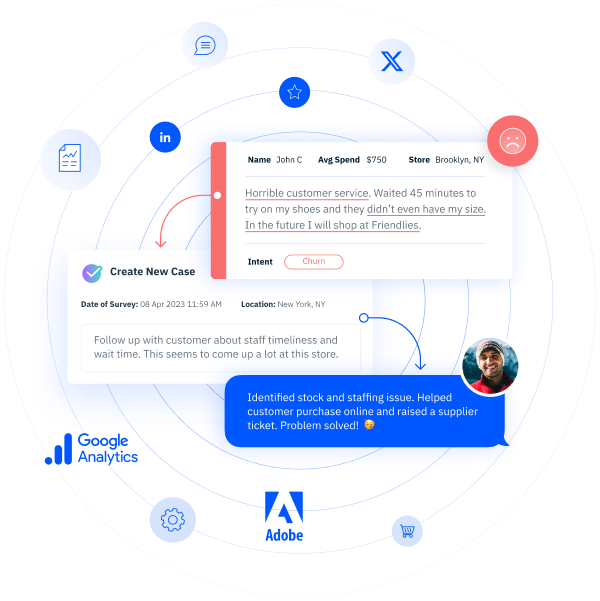
Customer Loyalty

Maintaining customer loyalty has become increasingly challenging in today’s digital-first environment. According to Stanford Swinton, Executive VP at Bain & Company and Founder at NPSx by Bain in Company, we’re witnessing the dawn of the “Third Wave of CX”. But what does this mean for CX leaders?

In a recent podcast featuring Simon Fraser, VP Insights and Consultancy at InMoment, and Stanford Swinton, key strategies to secure brand loyalty amidst the evolving landscape of customer experience (CX) were discussed. Here are the key highlights:

Understanding the Third Wave of CX

The evolution of customer experience (CX) functions mirrors the changing landscape of customer expectations.  The “third wave” of CX represents a paradigm shift in how businesses approach customer experience. Over the past few decades, CX practices have evolved significantly. Initially, the focus was on identifying the most suitable customer experience metrics, such as Net Promoter Score (NPS) or customer satisfaction scores. However, this approach has matured, shifting towards a deeper understanding of customer behaviour and feedback loops. Now, in the third wave, the landscape is changing once again. Best practices from five years ago are no longer sufficient. Personalisation has become paramount, necessitating a move towards customer-centric, predictive machine learning. This shift emphasises understanding customer value and leveraging AI to predict outcomes.

Personalisation and Ethical Differentiation

In the third wave, businesses must combine personalisation with values to stand out. While digital strategies and omnichannel experiences were once differentiators, customers now seek tailored experiences and align themselves with brands that stand for something meaningful. There’s a growing trend for companies to differentiate themselves based on their ethical principles and social missions. By prioritising customer enrichment and ethical practices, brands can establish a deeper connection with consumers, fostering long-term loyalty.

Predictive CX and Value Unlocking

Predictive CX goes beyond traditional surveys; it correlates customer sentiment with financial outcomes, providing actionable insights for business growth. Predictive CX leverages AI and machine learning to understand customer behaviour beyond survey responses and in turn, businesses can design targeted experiences that drive value and loyalty.  Understanding who your customers are and categorising their needs, journeys, and drivers of experience is essential. This involves creating a robust customer taxonomy to structure data sets effectively. Both structured and unstructured data play crucial roles in predictive CX. By harnessing predictive analytics, businesses can unlock value from their customers. 

Challenges and Opportunities for Businesses

Transitioning to the third wave of CX presents both challenges and opportunities for businesses. While legacy CX practices may pose initial hurdles, organisations can leverage existing frameworks and garner support from key stakeholders. By aligning CX initiatives with broader business objectives and demonstrating the potential for top-line growth, CX leaders can drive organisational change effectively.

Embracing the Third Wave

In conclusion, securing brand loyalty in the third wave of CX requires a proactive approach to adaptation and innovation. The shift to the third wave of CX is not just a trend; it’s a necessity for businesses looking to thrive in the digital age. By embracing personalised experiences, ethical differentiation, and predictive analytics, companies can secure brand loyalty and drive positive economic outcomes.

Ready to explore the full discussion on securing brand loyalty in the third wave of CX? Listen to the full podcast below!

Change Region

Selecting a different region will change the language and content of inmoment.com

North America
United States/Canada (English)
Europe
DACH (Deutsch) United Kingdom (English)
Asia Pacific
Australia (English) New Zealand (English) Asia (English)