Every business can agree that a sterling brand reputation does wonders for both the customer base and the bottom line—but how can companies build a better rep by leveraging customer experience (CX) tools? Additionally, why are CX programs (especially those that drive Experience Improvement (XI)) ideal for building a reputation that your existing customers will love and that new customers will find enticing? Today we’re covering three quick ways a CX-driven brand reputation helps your business:
Preserving the Base
Creating Shared Identity
Quickly Attracting New Business
Key #1: Preserving the Base
There’s no better way to retain your customers than through customer experience programs. Full stop. Advertising can be useful for keeping up a steady messaging drumbeat, but only a strong CX toolkit enables brands to continuously listen to customer preferences, identify broken touchpoints, and anticipate what those individuals will want from you next. Consistently applying these tools to gather intel, sharing that information across the organization, and taking united action on that intelligence will raise your profile among customers both new and old, effectively future-proofing your brand’s reputation.
Key #2: Creating Shared Identity
Tapping into customer preferences to create great products and services is essential, but it’s also important to understand who your customers are as human beings and not just as customers. Customers transact with the brands they feel share their values—an organization that can express desired values in its messaging, product offerings, and overall relationships will achieve sustainable success. Being known for serving customers well is one thing; being known for tuning into who customers are as people is another entirely.
Key #3: Quickly Attracting New Business
When a brand becomes known for delivering consistent experiences and values that customers connect to, new prospects will notice. CX programs’ unparalleled ability to deliver specific, actionable intelligence gives brands the chance to know, at a granular level, what will bring new customers to their doors. Again, advertising is important, but customer word-of-mouth following great experiences can be an even more effective way to acquire new business. That’s the power of CX-driven brand reputation in action.
What Comes Next?
We’ve briefly touched on how CX programs (especially Experience Improvement initiatives) are useful for capturing intelligence that improve your brand’s reputation. But which tools specifically should your brand utilize, and how? Click here to read my full-length Point of View article on the subject. I take a deep dive into the importance of a stellar CX reputation and how your business can achieve that same prestige efficiently. Thanks for reading!
Unlock Expert Guidance on Today’s CX Challenges & Opportunities
Whether you’re struggling with limited resources, data fragmentation, or evolving customer expectations, this guide offers the expert advice you need to elevate your CX strategy. Download now to discover how to transform these challenges into growth opportunities.
Thank you
Your download will begin shortly. If it doesn’t, click on the download button.
Get a first look at the trends that matter most and how they can impact your customer relationships, drive growth, and strengthen your overall strategy.
Thank you
Your download will begin shortly. If it doesn’t, click on the download button.
Frontline employees are constantly tasked with metrics—handle time, occupancy, attendance, and, of course, customer experience (CX). However, all of this focus on metrics can prevent our frontline teams from realizing the wealth of value they can bring to a CX program.
So How Can You Engage Your Frontline Employees in CX Programs?
There are a myriad of ways that I have operationalized during my time as a practitioner. And, additionally, I have also been able to see how many of our InMoment clients engage their employees in their CX programs.
For my post today, I’ve compiled a list of my top five methods for gaining CX buy-in from frontline employees. So without further ado, let’s get going!
Top Five Methods for Frontline Employee CX Buy-In
Broadcast the Value of Customer Experience
Create Recognition Opportunities
Show Employees How They Make a Difference
Include Customer Experience in Frontline Training
Use Customer Experience to Solve Specific Issues
Method #1: Broadcast the Value of Customer Experience
It is vitally important that the frontline teams (really the entire company) understand the importance of customer experience and, if practical, the primary CX metric that everyone is measuring. Having a theme or tagline that is shared everywhere is recommended. One of the health care companies I work with has a “Members First ” tagline that is used all around the company but especially in the contact center. All the representatives have been trained as to what their target metric, Net Promoter Score (NPS), is and why it is important.
Method #2: Create Recognition Opportunities
Create frequent opportunities to appreciate the frontline effort. “WOW” alerts, reader board messages (if we are ever in offices again), notes from site leaders when a positive comment is received from a customer …. It all goes a long way to instill a culture where excellent customer experience is celebrated.
Method #3: Show Employees How They Make a Difference
Leverage the frontline employees for continuous improvement initiatives. When I was a practitioner, I did employee roundtables and I Y-Jacked with frontline employees. I used those opportunities to validate what I was seeing in survey data. I actively solicited feedback and ideas on how to reduce customer friction directly from the source—the agents. I found that even if I could show just a small change as a result of my own or my team’s face-to-face interactions, the frontline teams became more bought into our CX program.
Method #4: Include Customer Experience in Frontline Training
Make customer experience a module in frontline training. Even if it is only a few minutes, show the trainees the survey text, share the “beacon” metric, and tell them why we emphasize customer experience. Explain how we learn from our customers what works well and what we can improve and truly stress how important they are to the process. Doing this in training introduces customer experience before they ever take a call or interact with customers.
Method #5: Use Customer Experience to Solve Specific Issues
Leverage very specific interactions for employee feedback with regard to customer experience. Many of our clients use our Resolve tool for case management. Part of our Resolve process is to capture employee feedback about the escalation interaction as part of the case closure process. We specifically ask them to help identify the root cause of the case and their suggestions to eliminate similar cases in the future. This creates a defined opportunity for the frontline reps to have a voice in how customers are served.
At the End of the Day…
Our frontline employees are the face of the company. If we get them bought into the program, they are the best advocates and ambassadors for customer experience. Celebrating them and asking for their opinions and insights are the best ways to get them—and keep them—engaged.
Want to learn more about how to engage your employees in the customer experience? Check out this eBook, “Better CX Begins with Employees”
Unlock Expert Guidance on Today’s CX Challenges & Opportunities
Whether you’re struggling with limited resources, data fragmentation, or evolving customer expectations, this guide offers the expert advice you need to elevate your CX strategy. Download now to discover how to transform these challenges into growth opportunities.
Thank you
Your download will begin shortly. If it doesn’t, click on the download button.
Get a first look at the trends that matter most and how they can impact your customer relationships, drive growth, and strengthen your overall strategy.
Thank you
Your download will begin shortly. If it doesn’t, click on the download button.
Creating a customer journey map is the first step toward designing a superior customer experience (CX) that drives end-user growth. Rather than rushing in and narrowly focusing on a single touchpoint to measure success, a customer journey map helps you evaluate the journey as a whole—providing a bird’s-eye view of the experience your brand delivers.
So You’ve Already Mapped Out the Customer Journey! What’s Next?
The urgent question then becomes, how do you take that big picture view and start asking your customers about their experience?
To move forward, you need to figure out which specific touchpoints you want to study, which metrics you want to gather, what questions you want to ask, and which channels are the most effective to collect that data.
Your customers are more than willing to tell you about the bottlenecks in their journey, but you’ll want to be thoughtful in your approach. So, before you start sending out surveys, think through your voice of customer (VoC) strategy using your journey map as a guide.
That’s what this post is all about. It will help you develop a strategy for gathering feedback at key points within your customer journey so you can take actionable steps toward optimizing your customer experience. Now let’s get started!
When in the Customer Journey Should You Ask for Feedback?
Before you begin asking away, it’s important to determine which pivotal touchpoints (otherwise known as make-or-break moments) within the B2B customer journey are ideal times to gather feedback.
Just to clarify, we are giving you a general idea of when to ask these questions, but this is not a turnkey solution. Every company’s customer journey map looks different, and your approach to asking the right questions at the right time will differ.
In fact, in all likelihood, you already have some sense of where the bottlenecks are in your customer journey and what needs improvement, so trust your intuition there.
And if you’ve got any doubt? The following touchpoints represent good places to start.
1. Onboarding Completion
Why is onboarding a make-or-break moment? Signing up for a new service always takes effort because you’re asking new customers to open their minds, learn about your product, and make a change by integrating your product into their lives. The more seamless you can make this stage, the more likely you are to gain a loyal customer.
2. Support Interaction
Why are support interactions make-or-break moments? We often think of customer support as its own thing, but it’s a vital part of the customer journey. The bane of product-led growth is friction, and by definition, a support interaction is a point of friction. No matter how usable your product is, some people will struggle with it.
Asking for feedback after a support case is closed will give you feedback on how your support team is doing. This will help determine resources support may need to speed customers through this touchpoint, identify bugs and usability issues, and draw attention to possible feature improvements.
3. Product Experience (Usually In-App)
Why is product use a make-or-break moment? This feedback will tell you what’s working as anticipated and what needs to be reconsidered. Customer feedback can and should influence your roadmap and guide the prioritization of development resources. Plus, SaaS companies are always trying out new features, and there’s no better time to survey your customers about those features than at the very moment they’re using them.
4. First Experience of Value and/or Pre-Renewal (Loyalty Check)
Why is the incomplete and/or pre-renewal experience a make-or-break moment? After a user has been up and running for a bit, they should be experiencing the benefits of using your product and services. It’s time to make sure they are. Asking for feedback at this touchpoint is meant to surface all kinds of things about their relationship with you (that you won’t hear after a support interaction, for example). Product, service, pricing, you name it. A survey response might give you the opportunity to fix an issue you didn’t know about and retain their business. And make sure to ask again pre-renewal to make sure your relationship is still on the right track.
How Might Your Approach Vary Depending on Your Business Model?
Let’s say you’ve got a self-serve product where customers get started quickly and they can see your product’s value upfront. In that case, it makes sense to ask the loyalty question (Net Promoter Score) early on in the customer journey because they’ve reached a point where they understand your value proposition.
On the other hand, if you send in consultants who spend weeks or more helping your enterprise users get up to speed with your product, you’ll probably want to wait a while to send that first NPS survey.
Just make sure that, whenever you ask the question, it makes sense to do so at that time. For example, asking someone how they feel about a new feature (PSAT) when they’re not currently using that feature makes no sense. Instead, ask them about the feature using an in-app survey, while they’re engaging the product. And of course, you wouldn’t want to ask someone about a support experience they had weeks earlier. Use common sense and put yourself in the customers’ shoes to deliver surveys that flow with their experience.
Remember: Rome Wasn’t Built in a Day, and Neither Is a Mature CX Program
Companies don’t generally implement voice of customer surveys at multiple journey points all at once—they roll out gradually, sometimes over 2-3 years. They might do one, then add another 6+ months later. A helpful tip is to start with the touchpoint that will give you the biggest bang for your buck in terms of learning, retention, and driving Customer Lifetime Value (CLV).
So What Questions Do You Ask?
When gathering voice of customer data, the most common feedback questions revolve around the things that drive product-led growth—like ease of use, customer satisfaction, and brand loyalty. With this in mind, the following metrics can help you assess these elements at key touchpoints: Customer Effort Score, Customer or Product Satisfaction, and Net Promoter Score. You’ll typically want to follow the rating question with an open-ended one asking the customer to explain the reasoning behind their score.
Now, you may be wondering: why not simply make up your own customer feedback questions tailored to your business, products, and customer experience? It may be tempting, but these metrics will give you a benchmark and scores that you can monitor over time to track whether you’re improving.
Need a Few More Reasons to Use Standard Metrics?
It’s much easier to get internal buy-in when using tried-and-true metrics employed by companies around the world. People can waste countless hours arguing over what questions to ask, but using established metrics can instantly end that debate.
These metrics are also extendable and extensible. In other words, you can extend the same questions to different products and features without reinventing the wheel. This makes it easier to roll out a CX program across a portfolio of products and brands.
And finally, these established metrics will stand the test of time, surviving personnel changes. Simply put, it’s an evergreen survey strategy.
What are the Metrics You Ought to Consider Tracking?
Choose your metric based on what you want to learn, and whether it will make sense to your customer in context. Remember, a survey is part of your customer’s experience.
What Is the Customer Effort Score (CES)?
Customer Effort Score (CES) lets you know how much work it takes for customers to accomplish something (e.g., onboarding, solving a problem).
CES surveys ask the customer “How easy was it to ________?” and is scored on a numeric scale. It’s a metric that is used to improve systems that may otherwise frustrate customers.
As a CX metric, CES helps with that “ease of use” component that increases Customer Lifetime Value (CLV). And while there’s no standard format for CES surveys, they usually look like a 5- or 7-point scale asking how easy it was for a customer to achieve whatever goal they were trying to accomplish. Take a look at our post abouthow to use CES to evaluate your onboarding experience for more details.
What Is Customer Satisfaction (CSAT)?
SaaS companies typically use CSAT surveys to get a read on specific interactions, such as a recently closed support ticket or a fresh purchase. You can format your CSAT survey as a numeric scale (e.g., 5- or 7-point). You’ll typically want to follow the rating question with an open-ended one asking the customer to explain their score.
What Is Product Satisfaction (PSAT)?
A Product Satisfaction (PSAT) survey measures customer satisfaction with your product or a specific feature, and you’ll often ask it with an in-app survey. Like CSAT, it’s flexible and you can ask the question in a variety of formats (binary +/- or on a 5- or 7-point scale).
What Is the Net Promoter Score (NPS)
There’s an excellent chance you’re already conducting NPS surveys at regular intervals, and that’s great! By combining NPS data with other key metrics listed here, you can get a good sense of the customer experience you offer across the entire journey. If you aren’t already using NPS, ask it after your customer has had a chance to experience value from your product or ask it prior to renewal. Both are good times to assess user loyalty.
Net Promoter Score measures brand loyalty, and unlike the other three metrics listed, it follows a standard format, which allows you to compare your results against industry leaders in your field. The standard NPS question asks: “On a scale of 0-10, how likely are you to recommend us to a friend or colleague?”
That NPS question should always be followed by an open-ended question asking respondents why they gave you the score they did. You will then use their answers to (1) have a customer service agent or a success manager follow up with the detractors to try to fix the problem and (2) use the response to improve your customer experience.
Remember: Less Is More
Have you ever taken a “brief” survey that stretched on far longer than promised? Most customers don’t want to take 3-4 minute surveys, and you can reduce friction and improve your survey response rate by using microsurveys.
Let people write a novel in response to your open-ended questions, that’s great—you’ll learn a lot from them! But put yourself in your customers’ shoes and keep your surveys short and sweet, gathering a relevant metric upfront.
Which Distribution Channels Should You Use to Gather Feedback?
Emails, SMS, and in-app surveys are the three main survey channels typically used to gather customer feedback on a post-acquisition journey. Once again, use common sense and think about the channel that makes the most sense for the user. Product experience, as mentioned above, is almost always best asked through in-app surveys at the moment they’re in your platform or app. Support experience is often assessed with an email survey. SMS can be a great channel for gathering feedback if you’re already communicating with customers via phone—for example, following up on a cable technician’s visit.
Just like the question of “when” to collect data, the question about how to distribute surveys will sometimes produce different answers based on your business model. For instance, if you’ve got a more complicated onboarding process where end-users interact with customer success a fair bit, they won’t be surprised to receive a survey via email. On the other hand, if you have a largely self-serve product where onboarding is straightforward, it makes sense to conduct the CES survey in-app.
As you gather data and begin to analyze it, it’s important to remember that none of these metrics or the touchpoints they evaluate exist in isolation. The real secret to a successful CX strategy is to take a step back and look at the entire journey—understanding how it’s all interconnected.
This is where it helps to have a cross-functional team, often led by someone with responsibility for CX operations, that can step back and look at an implementation plan. They can then unify all the data and connect information across the tech stack (e.g., Zendesk, Salesforce, Gainsight, InMoment.
Without this holistic approach, it’s easy to develop departmental silos (where everyone focuses exclusively on their own touchpoints) and technological silos (e.g., the Sales team sees what’s in Salesforce, and the Customer Support team sees what’s in Zendesk, but nobody sees the big picture).
Tasking a team with developing a big picture approach to evaluating the entire customer journey is an essential ingredient in creating a consistent customer experience. And a consistent, seamless, enjoyable experience will build loyalty and boost customer value in the months and years to come.
Unlock Expert Guidance on Today’s CX Challenges & Opportunities
Whether you’re struggling with limited resources, data fragmentation, or evolving customer expectations, this guide offers the expert advice you need to elevate your CX strategy. Download now to discover how to transform these challenges into growth opportunities.
Thank you
Your download will begin shortly. If it doesn’t, click on the download button.
Get a first look at the trends that matter most and how they can impact your customer relationships, drive growth, and strengthen your overall strategy.
Thank you
Your download will begin shortly. If it doesn’t, click on the download button.
Whether your customers are visiting your storefront, browsing your website, unboxing your product on TikTok, or reading a review site, consumers interact with your brand in countless ways and places. But how do customer experience (CX) programs keep up with a customer journey that is constantly changing? A good place to start is going beyond traditional survey solutions to include more modern methods, listening posts, channels, and feedback types—solicited, unsolicited, and inferred.
Not all valuable feedback gathered is solicited in the form of surveys, focus groups, or interviews (also known as direct feedback in the CX world). There is a wealth of unsolicited—or indirect feedback—in call centre recordings, social media feedback, and web chat transcripts. A company can also use inferred feedback by tracking customers’ behaviours, contact frequency or purchasing habits.
This post is all about going beyond direct and indirect survey options and questionnaires, and expanding your program to include inferred feedback. When you meet customers where they are, however and whenever they’re interacting with your brand, you are opening the door to big picture understanding, big picture improvements, and, most importantly, big picture results.
So, What’s Inferred Customer Feedback All About?
According to Gartner analysts, inferred feedback is operational and behavioural data associated with a customers experience or customer journey, like a website’s clickstream data, mobile app location data, contact centre operational data, or ecommerce purchase history.
Bringing Inferred Feedback to Life
As an example of all three feedback sources working together, let’s imagine a shoe retailer’s CX team launching a new release sneaker in store—and they’re on the hunt for actionable intelligence. There are multiple touchpoints along the journey to analyse in order to launch this product successfully.
When customers buy shoes (or anything else) at the store, they are given scannable QR codes on each receipt for direct feedback. They might take the survey, rate their in-store experience, and say they buy shoes there every 12 months, on average.
For indirect feedback, the CX team would also look at reviews on their mobile app, Facebook, Instagram and YouTube to see what customers are saying about the latest and greatest sneakers. We can use text analytics tools to find common data themes as well as positive, negative, and neutral sentiment in a customer’s verbatim feedback. The CX team can also look into web chat notes, which might show how many people have contacted you asking for more details, stock levels or sneaker quality in the past.
The last step is to look at inferred feedback. When it comes to sneakers, it will be useful to look at purchase history through a CRM, a loyalty program, or a customer’s store account, which will show an important operational and segmentation piece of the puzzle. From your analysis, you might learn a few things:
the average repurchase cycle is 18 months
those customers purchasing more frequently are your fanatics, more likely to be singing your praises and spreading the word
your neutral customers are being nice and predictable
the skeptical, non-loyalists come and go as they please
When you combine this behavioural insight with the direct and indirect feedback that corresponds to each segment, you are painting a better picture of what is driving customers to act in certain ways.
Are the fanatics more forgiving of experiences, more excited, or even demanding more of you? What does this intelligence tell you to do? Increase stock levels, super-charge loyalty bonuses, or pivot?
When you put all of these pieces into your data lake, you now have all the information you need to form a rich, single view of the customer. From there, you can start making sense of the data and creating a world-class action plan.
How Do I Take Action on Inferred Customer Data?
A problem many businesses are facing is how to link all sources of collected feedback together, turn it into something they can act on, and truly transform their business. Luckily, we have a few tips for going beyond insights to take action:
Action Step #1: Get the Right Reports to the Right People
When it comes to bringing inferred data to life, optimised reports are a superpower. Spend the time up front to figure out which insights deliver relevant, actionable, and effective intelligence, then to get that intelligence to the right people. We recommend creating reports that are customised, metric-specific, and delivered in real-time, and then looking for those CX advocates in your business who have the power to do something with them.
Action Step #2: Put Your CRM Data to Work
Integrating CRM data with your traditional feedback data can be a game changer. It helps you understand more about the customer to create more informed, personalised interactions that can boost average basket size, increase purchase frequency and drive brand advocacy to new levels.
Action Step #3: Resolve Issues Quickly
Your inferred data will show when customers are at risk of churning. This is a great opportunity to intervene quickly, and turn an unhappy customer into a lifelong advocate. One of the most important actions your CX program should take is responding to customer issues quickly and efficiently, be it negative feedback, a bad social review, or knowing a customer had a difficult time processing a refund.
Unlock Expert Guidance on Today’s CX Challenges & Opportunities
Whether you’re struggling with limited resources, data fragmentation, or evolving customer expectations, this guide offers the expert advice you need to elevate your CX strategy. Download now to discover how to transform these challenges into growth opportunities.
Thank you
Your download will begin shortly. If it doesn’t, click on the download button.
Get a first look at the trends that matter most and how they can impact your customer relationships, drive growth, and strengthen your overall strategy.
Thank you
Your download will begin shortly. If it doesn’t, click on the download button.
Your brand might be asking, “why does our customer experience program need a case management system?” Well, to answer your question, statistics show that 43% of people spend more money on brands they’re loyal to and a 5% increase in customer retention can lead to a 25% increase in profit or more, according to statistics about customer loyalty. Implementing a case management system can develop customer loyalty by addressing systemic issues within your organization.
Of course, there are more specific reasons as to why a case management system satisfies customer needs so well—but before we dive in, let’s take a look at some case management basics!
What Is a Case Management Program?
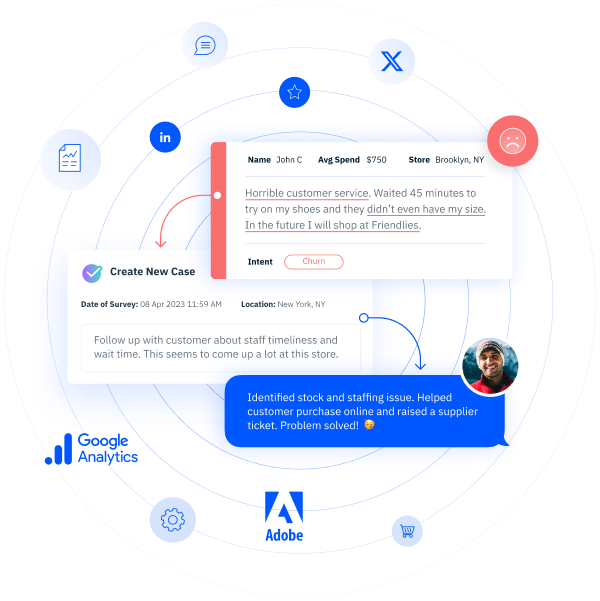
A case management program is a closed-loop system that incorporates intelligent alerts, text analytics, and prescriptive recommended actions to address high-risk to high-potential customers. These programs allow brands to reach back out to such customers and “make it right,” which not only remedies any disgruntled feelings, but has been proven to increase customer loyalty. In fact, 70% of the time, a person will become a repeat customer when a complaint is resolved in the customer’s favor.
Why Do You Need a Case Management Program?
Streamlines the Communication of Customer Experience Survey Results
Facilitates a Follow-Up Procedure When a Customer Has a Problem
Organizes Data for Updating Your Customer Experience Program
Reason #1: Case Management Programs Streamline the Communication of Customer Experience Survey Results
A common issue brands have after writing a viable survey (NPS, CSAT, or CES) and figuring out the most effective ways to deploy it is, “how do we collect the responses and get them to the right people?” After all, with so many surveys being sent out, it can be intimidating to think about how to act on all the results.
We recommend having an alert feature in your case management system that notifies you when, for example, a low score is given on a survey. And when that happens, then you can assign the case to the right team. This way, customer complaints or low scores are identified first in your survey results and the information will bypass unnecessary obstacles so that the appropriate employee receives it.
Case management systems can ease a lot of the inconveniences that come with managing so much information. By streamlining communication, your brand can avoid a big headache.
Reason #2: Case Management Programs Facilitate a Follow-Up Procedure When a Customer Has a Problem
Now that you know a customer has a problem, you need to respond with a solution. Because when building customer loyalty, you never want to leave a problem unresolved. Which brings us to our second reason: case management systems allow responders to facilitate the follow-up process and effectively close the loop.
After assigning cases to frontline personnel, it’s helpful to have the system automatically send it to an inbox where those employees can check it every business day. It is also important to employ a status hierarchy for each case—like new, in progress, closed, or overdue. With this simple strategy to divide up cases, your organization has a clear process to address customer problems.
Negative survey results can be an overwhelming beast to tackle, but with a case management system it can get that much easier.
Reason #3: Case Management Programs Organize Data for Updating Your Customer Experience Program
Guess what? Now that you have all those customer cases in one place, your business can use that data to improve your CX program.
The best way to do this is by incorporating information from the case management system into reporting dashboards as a new data set. Through this, you can understand how well your case management system is performing and have the opportunity to learn about the larger issues in your CX program—and across your business. Each problem a customer encounters is a hint at a possible systemic inadequacy.
As your company grows bigger and bigger, it becomes more difficult to interact with customers and build the loyalty you need to push your business forward. But with a case management system, communication is strengthened so employees can work smoothly together while sorting out customer feedback—and improving experiences all the while.
Interested in learning more about how case management programs can give your business an extra edge? Download this white paper to read about our six best practices to set up a top-notch case management program.
Unlock Expert Guidance on Today’s CX Challenges & Opportunities
Whether you’re struggling with limited resources, data fragmentation, or evolving customer expectations, this guide offers the expert advice you need to elevate your CX strategy. Download now to discover how to transform these challenges into growth opportunities.
Thank you
Your download will begin shortly. If it doesn’t, click on the download button.
Get a first look at the trends that matter most and how they can impact your customer relationships, drive growth, and strengthen your overall strategy.
Thank you
Your download will begin shortly. If it doesn’t, click on the download button.
Like many superannuation funds, legalsuper has had to quickly adapt to increased customer demands in response to legislation change and economic and global events like COVID-19. Like many businesses, legalsuper did its best to adapt to the increase in demand, but knew there was a better way to provide outcomes to its customers.
The answer? Customer Experience! The business used real-time intelligence to react quickly to COVID-19 demands, which enhanced customer experiences through the pandemic and beyond.
Elizabeth Swartz, legalsuper’s Manager of Insights and Service Design, shares how her team built a business case for a customer experience platform, and how this helped their brand adapt and evolve to a changing industry.
Pro-Tip #1: Establish Financial Linkage
The most compelling part of the business case was financial linkage. Swartz focused on the value of a customer feedback loop and drew a line back to ROI. She knew if the business could reach detractor customers and recover them from churning, it would help impact legalsuper’s bottom line and make sure members are happy with the service they receive.
Pro-Tip #2: Show the Impact Your Program Can Have by Explaining Top-Line Growth
Top line growth and increased revenue from an experience management perspective looks like retaining existing customers, finding new customers, discovering opportunities to cut the costs involved with serving customers and establishing sustainable, recurring revenue.
Pro-Tip #3: Describe the Coaching and Performance Impact to Your Call Centre
A CX program can involve real-time insights that help your front-line staff become more efficient. In legalsuper’s case, the business was able to save the contact centre from pulling lists and analysing insights, as this was now done automatically in the platform.
The Results? Direct and Immediate Business Value
Whilst the program is still new, Elizabeth says that it’s easy to see the value. Every time a new part of the program is implemented, the value is clear right away. Some of the immediate improvements to the business have been:
Unlock Expert Guidance on Today’s CX Challenges & Opportunities
Whether you’re struggling with limited resources, data fragmentation, or evolving customer expectations, this guide offers the expert advice you need to elevate your CX strategy. Download now to discover how to transform these challenges into growth opportunities.
Thank you
Your download will begin shortly. If it doesn’t, click on the download button.
Get a first look at the trends that matter most and how they can impact your customer relationships, drive growth, and strengthen your overall strategy.
Thank you
Your download will begin shortly. If it doesn’t, click on the download button.
Humans are emotional creatures whose search for meaning influences which brands they want to share experiences with. That’s something that many companies strive to provide, but more often than not, the customer experience (CX) programs they use are built around reporting and increasing metrics, not providing a bolder and more human interaction. Numbers are certainly important, but creating a more connective experience for customers isn’t just good for them—it’s great for your employees and your bottom line.
Here’s how to make your experiences more emotional and more connective in three steps:
Gather Unstructured Data
Disseminate Findings
Execute
Step #1: Gather Unstructured Data
Metrics are great for telling a brand that a problem might be occurring somewhere in the customer journey, but that’s about all they can tell you. Unstructured data, on the other hand, consists of what customers are saying about your brand and the experiences it provides. This type of raw, expressive feedback is crucial to creating a more emotional experience, which means that brands everywhere need to focus on gathering and analyzing it.
If you haven’t already, take some time to consider what questions your customers would enjoy answering. Perhaps more importantly, put space in your surveys and feedback collection tools that allows customers to express themselves in their own terms. This strategy enables organizations to learn what customers consider most important about an experience and alert them to touchpoint breakages that companies themselves may not even know about. It also allows brands to put that customer sentiment toward a more connective experience.
Step #2: Disseminate Findings
Once you’ve gathered unstructured feedback and fed it into an experience platform that can analyze it for actionable insights, it’s vital that that intel be shared with the rest of the organization. A lot of companies keep these findings siloed up with their CX teams, but roping other departments into the process allows everyone to make the improvements necessary for a more emotional experience.
This process is also essential for better understanding your customer. When every team in the company collaborates, you can paint a 360-degree picture of your customer, which creates a deeper understanding of who your customers are and what meaning they seek from you. This further allows your organization to make an emotional experience, as well as tweak nearly anything else about both transactions and relationships to create Experience Improvement (XI).
Step #3: Execute
This is another area where a lot of brands fall short with their experience programs. They put a lot of time into gathering findings, but stop short of actually executing on them. Putting this work in is far from easy, but it’s absolutely essential to creating a more emotional experience for your customers. Tie your program actions to concrete financial goals and closely monitor how things go. Making your goals as quantifiable as possible doesn’t just simplify tracking progress; it also makes asking the board for more funding a lot easier when you have numbers to back your success up.
Creating emotional customer experiences is essential in a world of fierce competition. When customers feel they have a special bond with you, they’ll keep coming back even when other brands are trying to woo them. Experience Improvement (XI) also creates a much stronger bottom line for your brand, enabling you to become a marketplace leader or maintain your dominance in your vertical.
Click here to learn more about the power of emotional customer experiences. Kristi Knight, our CMO, applies decades of marketing and CX expertise to a strategy that will empower your brand to build better customer relationships, make more revenue, and find greater marketplace success all in one motion.
Unlock Expert Guidance on Today’s CX Challenges & Opportunities
Whether you’re struggling with limited resources, data fragmentation, or evolving customer expectations, this guide offers the expert advice you need to elevate your CX strategy. Download now to discover how to transform these challenges into growth opportunities.
Thank you
Your download will begin shortly. If it doesn’t, click on the download button.
Get a first look at the trends that matter most and how they can impact your customer relationships, drive growth, and strengthen your overall strategy.
Thank you
Your download will begin shortly. If it doesn’t, click on the download button.
To meet your customer experience (CX) goals, you first need to understand the current state of your customer journey. But gaining the level of understanding necessary is easier said than done. The customer journey is made up of countless moments—even a CX program with boundless resources wouldn’t be able to examine them all! The key is, then, to focus on the moments with the greatest impact on your customers, be they positive or negative. And that’s where customer experience analytics come in.
What Are Customer Experience Analytics?
Many of you may be familiar with the basics of CX analytics, but for those of you who could use a primer, we’ve got you!
Customer experience analytics concern the strategic process of discovering, collecting, and analyzing customer data in order to obtain the intelligence businesses need to inform the decisions they make.
Whether this customer data is solicited (through email or SMS surveys or in-app/online intercepts) or unsolicited (via review sites or social media), the right customer experience analytics can pick up on opportunities for improvement throughout the customer journey.
Identifying Moments of Impact with Customer Experience Analytics
There are various vendors that offer customer experience analytics (you can check out a third party analyst ranking here), but today, we are going to talk about a specific solution: Touchpoint Impact Mapping.
Touchpoint Impact Mapping is a unique analytical approach that brings the emotional state of the customer journey to life at every touchpoint. This approach is based on behavioral sciences’ “Peak-End Rule,” which states that our perception of our experience with anything—a brand, a person, a place, etc.—is largely shaped by intense positive or negative moments within that experience.
This approach, unique to InMoment’s Strategic Insights Team, discards traditional survey metrics, analyzing only customers’ comments for frequency and emotional intensity. This analysis highlights the “peaks” across an experience in a visual map which pinpoints areas of experience excellence that should be celebrated, as well as touchpoints that should be improved.
Not only does it show brands where to focus their efforts, but Touchpoint Impact Mapping also clarifies what about those touchpoints elicited such emotional intensity from the customer. For instance, if the onboarding process was identified as an emotional low, customer experience analytics would reveal that customers found the process confusing. To improve the experience in this area, the brand could publish an FAQ article, rewrite directions, or include additional context on the webpage.
Want to Learn More About Touchpoint Impact Mapping?
If you’re in the market for customer experience analytics that can help you focus your resources on the moments that truly matter, you can learn more about Touchpoint Impact Mapping from InMoment’s Senior Insight Design Specialist Dan Jones in this video:
Want to see a Touchpoint Impact Map in action? Contact our team to demo our unique solution!
Unlock Expert Guidance on Today’s CX Challenges & Opportunities
Whether you’re struggling with limited resources, data fragmentation, or evolving customer expectations, this guide offers the expert advice you need to elevate your CX strategy. Download now to discover how to transform these challenges into growth opportunities.
Thank you
Your download will begin shortly. If it doesn’t, click on the download button.
Get a first look at the trends that matter most and how they can impact your customer relationships, drive growth, and strengthen your overall strategy.
Thank you
Your download will begin shortly. If it doesn’t, click on the download button.
Customer experience (CX) programs have been laser-focused on numbers ever since the experience space came into being. A lot of organizations consider achieving high scores in NPS, OSAT, and the like to be the holy grail of customer experience, and a goal that every program must be tuned to. After all, if scores are high, that must mean customers are consistently happy, right?
The truth is a bit more nuanced than that, which isn’t to say that metrics aren’t useful—they’re great for letting an organization know that a problem might be occurring at one touchpoint or another. Unfortunately, that’s about all they can telegraph. They’re good for letting brands know that a problem is occurring somewhere in the process, but there are two major brand experience factors beyond that that they can’t clue brands into: brand perception and shared values.
Key #1: Brand Perception
Numbers alone cannot tell you how customers perceive you. The only way to gather that insight is by allowing your customers to submit unstructured, open-ended feedback, then analyzing that feedback for intelligence that you can act upon. Understanding how your brand is perceived can be tricky, even frustrating if you’re contending with perceptions you feel are beyond your control. However, knowing how your customers perceive you is vital to building long-term relationships with them.
More directly, brand perception plays a huge part in individual customer transactions and product experience. In many respects, it may not seem like perception should impact individual interactions, but remember that how customers see you influences whether they want to do business with you in the first place! Understanding how your brand is perceived can give you an opportunity to achieve Experience Improvement (XI), so compare customers’ unstructured feedback to your own messaging goals and work on the gaps preventing a bridge between the two.
Key #2: Shared Values
Every brand has a perception it wants to achieve for both its target audience and the wider world. We’re sure you’ve seen how many companies strive for an environmentally friendly or ethical image. That idea of shared values is also tremendously important to customer relationships, customer experience, and brand experience, and it’s another factor that brands can’t account for with numbers alone.
Much of customers’ trust in your brand is built on the values and identity they feel they share with you, even in a product experience sense. So, similarly to brand perception, go beyond numbers by letting customers tell you why they feel that bond with you, or why they may not. You can then create experience initiatives that build upon what customers see, or want to see, in your organization and the values that you express in your brand mission. When customers feel that fundamental connection to a brand, they’ll continue to come to you even when competition and other market forces are intense.
Click here to read our full-length point of view paper on brand experience. Expert Simon Fraser takes a deep dive into how these forces impact everything from transactions to relationships, and how your organization can leverage them to create Experience Improvement!
Unlock Expert Guidance on Today’s CX Challenges & Opportunities
Whether you’re struggling with limited resources, data fragmentation, or evolving customer expectations, this guide offers the expert advice you need to elevate your CX strategy. Download now to discover how to transform these challenges into growth opportunities.
Thank you
Your download will begin shortly. If it doesn’t, click on the download button.
Get a first look at the trends that matter most and how they can impact your customer relationships, drive growth, and strengthen your overall strategy.
Thank you
Your download will begin shortly. If it doesn’t, click on the download button.
Let’s be frank—establishing a customer experience (CX) program’s return on investment (ROI) is one of the greatest challenges that CX practitioners and the organisations they serve face in the modern experience landscape.
Did you know, according to Forrester research, only 14% of CX Professionals strongly agreed that ROI from CX is well established in their firm?
Across all businesses, the entire C-Suite leadership team is looking to validate an experience program by understanding: what is the financial impact of my CX investment?
The dilemma we face as CX and EX professionals is that across our organisations people can rationalise the need and function of excellent customer experiences with relative ease. We easily create an “emotional connection” and take the leap of faith that our belief will be true.
However, at a business level, when we are looking to make decisions to invest more in our voice of customer and voice of employee programs, we as CX/EX professionals often struggle to show the return on the CX and EX investment and thus can miss out on further invested funds as the rational minds look to maximise returns on what is tangible.
Here are some suggestions I’ve put together to enable the organisation to be customer centric, but also to understand how that centricity adds value to the organisation beyond “emotional connection”.
First Up: Map Your Program to Economic Pillars
In order to prove business value, it’s essential to draw a line back to economic pillars. Here are a few examples of economic pillars that could be affected by your experience program:
Customer Acquisition. Understand the market environment and changing consumer preferences.
Customer Retention. Address organisational or procedural issues that negatively impact customer experience.
Cross-sell and Upsell. Identify opportunities to expand loyalty and share of wallet within existing customer base.
Minimise Costs. Find areas for achieving greater efficiency, eliminating unnecessary elements.
Next: Understand Your Driver Tree
While the industry conditions and expectations for a CX investment vary from one organisation to another, there are basic ingredients across the board that should be included in your benefits driver tree.
CX practitioners have a much greater chance of proving financial linkage between CX and ROI if they can demonstrate CX’s ability to increase revenue, decrease costs, and reduce capital.
These pillars are fundamental to how a company’s CEO and CFO manage a business (and how both shareholders and the broader market evaluate a brand’s future viability).
When looking at the wider driver tree there are some more common areas of focus the VoC programs can focus on like a reduction on failure demand costs, a reduction of churn, an increase in tenure and more—see graph below.
Finally: Build Your Financial ROI Roadmap
To win the minds of your executive leadership team, it’s really important for each listening post (i.e. survey program) to think about the related operational and finance measures already being used by the business and link to those so the program is relevant. In other words, you need a financial ROI roadmap to continually point back to.
For example, your roadmap might include steps to reduce repeat calls or reduce wait times. An in-person brand could be focused on sales, basket size, queue time. For an episode survey like onboarding, it could be increasing product/service uptake or reducing early tenure churn. Your organisation already has success metrics that it’s focused on. Find out what these are and draw a link.
Focus where you can on cost saving assumptions first, as these models are typically easier to defend than revenue based models (e.g. reducing churn, increasing share of wallet, increasing average tenure or LTV). They generally require less calculations, less assumptions, and less time to prove an impact. For example, failure demand—where you identify the issues that drive avoidable contacts into the organisation—can be much quicker to identify and act upon. Empowering frontline teams to deliver better outcomes, increasing engagement and reducing staff attrition (or turnover) is another. But something like proving the multiplier effect on acquisition (so how WOM drives new business) is often a lot harder.
Unlock Expert Guidance on Today’s CX Challenges & Opportunities
Whether you’re struggling with limited resources, data fragmentation, or evolving customer expectations, this guide offers the expert advice you need to elevate your CX strategy. Download now to discover how to transform these challenges into growth opportunities.
Thank you
Your download will begin shortly. If it doesn’t, click on the download button.
Get a first look at the trends that matter most and how they can impact your customer relationships, drive growth, and strengthen your overall strategy.
Thank you
Your download will begin shortly. If it doesn’t, click on the download button.
You’ve heard us talk about how your employees are the best resource you have when it comes to experience improvement, but how do you truly harness their power? What decisions and changes can you make in the boardroom that empower employees in the breakroom to deliver on customer experience?
The truth is that training for a customer-centric culture on a location-by-location basis is simply not enough. Because when it comes down to it, turning your employees into your best customer experience advocates is an initiative that needs to be led, enforced, and encouraged on an organizational scale.
If you’re looking to get started and lead the way for your organization, we’ve broken down your mission into four key parts. And we’re including specific actions you can take to transform your employee culture into something that puts the customer at the heart of everything. Let’s dive in!
Mission #1: Dial in on Core Competencies
To get anywhere, you first need to understand where you’re headed, right? This is especially true for your Experience Improvement (XI) strategy.
At the beginning of your journey to a customer-centric culture, you must first craft detailed definitions of the competencies required for employees to deliver on your organization’s ideal customer experience. Additionally, it wouldn’t hurt to audit the level of the required competencies in staff who are currently carrying out customer experience management roles and compare them to your required standards.
Once you understand where you are and where you want to be, you can implement a competency development plan that includes a mix of formal training, on-the-job coaching, mentoring, self-learning, etc.
Examining legacy and new training initiatives that impact customer-facing staff allows you to ensure that the messages and techniques employees promote are consistent with your organization’s customer experience strategy.
Mission #2: Publicly Encourage a Customer-Centric Culture
Now that you know what your end goal is, don’t let your mission of creating a customer-centric culture be an afterthought in your organization. Be loud about it!
You should have plenty of examples of best-case scenario customer/employee interactions from your feedback data, so take advantage of them. Regularly share examples of behaviors that illustrate your organization’s desired customer culture. You should include perspectives about what individuals did and indicate why those specific actions had such a positive impact on customers. You can do this in an internal newsletter or use our Moments app to share with company leaders.
Additionally, make sure you’re in constant communication with human resources. You need to ensure that recruitment processes have explicit steps in place in order to check that potential candidates possess the attitudes and beliefs that are consistent with your organization’s customer culture. That way, any person you bring in is already on the same customer-centric path as your company.
Mission #3: Engage and Motivate Employees
You’ve started openly and actively discussing your customer-first perspective; now it’s time to get employees motivated to join in.
Within key teams, identify social leaders or customer experience all-stars and harness their influence by asking them to lead training exercises. Be sure to arm them with coaching materials and other collateral that break down your organization’s approach to customer experience. You can even supply them with feedback data so they can relay to the team exactly what behaviors or processes need to be replicated or improved.
At the same time as you want to be a cheerleader for your initiatives, it’s also important to understand the questions and potential resistance some line managers and supervisors may face when implementing any changes. That’s why it’s vital to hear them out and support them via training, supplemental materials, and processes to implement desired actions and maintain continuous improvement.
Additionally, you need to be mindful when it comes to employee incentives. You want to be sure that reward structures reflect your customer strategy. For example, many CX programs have shifted their focus from metrics to big-picture business improvements via customer acquisition, retention, cross-sell and upsell efforts, or by reducing costs. When they make this shift, they often change their rewards programs from incentivizing customer surveys to rewarding employees who have been shouted out by customers for providing an exceptional experience.
Mission #4: Organize with Customers in Mind
Just as your training initiatives and rewards programs need to be aligned with your Experience Improvement strategy, so too must your org chart and processes be equally aligned.
Review existing barriers to delivering your desired customer experience, paying particular attention to handoffs between functions/departments and to potential conflicts in functional objectives and targets.
For instance, let’s say that customers are complaining that it takes too long to have an issue resolved in your online portal. You investigate and find that, in order for any online portal issues to be fixed, a customer must call up your contact center, which in turn must hand that customer off to the IT team in order to actually fix the issue. An organizational solution to such a problem would be to have a team in your contact center dedicated specifically to online portal issues so there is no lengthy handoff.
Additionally, your customer team should have a window into any proposed organizational change to assess—and, if necessary, mitigate—any potential negative impact that changes might have on the customer experience. Remember, your goal is to have everything in your organization—including the way your org chart is structured—work toward the good of your customers.
Strategizing for Experience Improvement
In the end, Experience Improvement isn’t something that can merely happen overnight. It takes hard work and dedication to create a customer experience that keeps customers choosing you over the competition. And, in a world where customers have more options than ever before, being able to differentiate on the experience means everything, making your experience improvement strategy something everyone—board members and frontline employees alike—can get behind.
Unlock Expert Guidance on Today’s CX Challenges & Opportunities
Whether you’re struggling with limited resources, data fragmentation, or evolving customer expectations, this guide offers the expert advice you need to elevate your CX strategy. Download now to discover how to transform these challenges into growth opportunities.
Thank you
Your download will begin shortly. If it doesn’t, click on the download button.
Get a first look at the trends that matter most and how they can impact your customer relationships, drive growth, and strengthen your overall strategy.
Thank you
Your download will begin shortly. If it doesn’t, click on the download button.
Cross-selling and upselling customers gets a bad rap in the world of customer experience (CX). A lot of brands hesitate to enact full-on initiatives because they don’t want to come off like the worst stereotype of a pushy car salesperson to their clients, and while that’s a worthwhile concern, it’s not the true nature of cross-selling and upselling. In fact, when handled properly, cross-selling can let your customers know that you’re not just interested in their money; you’re invested in their success and the part you play in achieving that. If you want to learn how to telegraph that to your customers, you’re in the right place!
Being Mindful
The first tip we can provide for good cross-selling/upselling is to be mindful of what your client expects. This doesn’t ‘just’ apply to your product—it also applies to your relationships with your point(s) of contact and when customers expect you to reach out to them. Knowing that cadence is its own reward, but it also helps clients stay secure in the fact that you respect their time and bandwidth.
Another, deeper factor here is the notion of a holistic customer, which means getting your company’s departments together and working off of a singular, 360-degree view of said customer. Not only does this help your brand deliver a better experience, but it also helps you know what your customer expects, which informs your cross-selling/upselling strategy.
Best Practices
When you’re ready to upsell, make sure you reach the right point of contact. We know; that point sounds obvious, right? But consider that each part of your offering could sound more or less relevant to multiple people. So don’t bother reaching out to finance about your new marketing tool; instead, take the time to figure out who to talk to in marketing (CX tools are great for this legwork). That way, you’ll be able to reach the person who actually cares about a given part of your product, and they’ll appreciate that you did your homework to find them.
Once you find that person, be prepared to quantify your new feature’s business value. Don’t just reach out to clients thinking that they’ll appreciate a new element solely because it’s new—that approach is guaranteed to give off boiler room telemarketer vibes. Rather, focus not just on knowing what your new feature would do, but how it can help your customer specifically. Case studies, proposed use cases, and the like are extremely powerful tools here.
Good Intentions
This approach to cross-selling and upselling takes more time and effort than reactively reaching out to clients every time you have something new… but it’s also a much more successful tactic. Yes, getting the upsell is great, but doing the due diligence that our approach calls for also lets your clients know that you’re genuinely interested in their business success! When you’ve demonstrated that interest, your clients won’t just be quicker to pick up the phone at the same time next month; they’re going to actively anticipate what you come up with next. In other words, cross-selling and upselling the right way meaningfully improves customers’ interactions with your brand, making it simple to strengthen your bottom line and those relationships in a single motion.
Want to read more about how you can inform successful cross-selling and upselling efforts that will positively impact your bottom line? Read the full article by experience expert Jim Katzman here!
Unlock Expert Guidance on Today’s CX Challenges & Opportunities
Whether you’re struggling with limited resources, data fragmentation, or evolving customer expectations, this guide offers the expert advice you need to elevate your CX strategy. Download now to discover how to transform these challenges into growth opportunities.
Thank you
Your download will begin shortly. If it doesn’t, click on the download button.
Get a first look at the trends that matter most and how they can impact your customer relationships, drive growth, and strengthen your overall strategy.
Thank you
Your download will begin shortly. If it doesn’t, click on the download button.