Customer Journey Analytics

Each key touchpoint throughout the customer journey plays a huge role in how a customer judges their experience as a whole. This means that at every touchpoint, the stakes are high and there’s a risk of damaging your brands’ reputation. And the scariest thing? It’s not enough to do the work to understand the customer journey at one point in time; businesses need to constantly keep up because customer journeys evolve overtime. That’s where customer journey analytics can come into the picture!

With the appropriate analytics and action, your company can prevent mistakes along the customer journey from happening. Our eBook, Understand and Predict Your Customers’ Needs with Customer Journey Analytics, breaks down a three step process to improving your brands’ customer journey. Let’s get right into it!

  1. Get the Inside Scoop
  2. Pinpoint the Target Areas
  3. Strategize for the Future

Step #1: Get the Inside Scoop 

The customer journey can often feel like a never-ending puzzle. How do we create the best experience for a bunch of strangers? Well, that’s correct, customers are technically strangers, which makes it infinitely harder to cater to them. A logical first step then is to get to know your customers!

With powerful customer experience technology, InMoment can help your brand eliminate silos and combine data according to segmented groups, so you can feasibly sort through all sources of customer feedback, whether they’re solicited (phone, email, or text surveys etc.) or unsolicited (social, third party review sites, and more). Seeing these data points altogether can give you a general idea of how your customers behave, what they care about, and more. When you have an inside scoop on how your customers are interacting with your brand, suddenly, customers aren’t strangers anymore but people you can get to know better and better!

Step #2: Pinpoint the Target Areas

One of the benefits of having data collected from a myriad of sources is the ability to statistically analyze trends, patterns, and anomalies. By measuring what topics have the most traffic, your company can focus its priorities on the issues that matter. Leveraging customer journey analytics to identify the impact of a topic often proves to be a big time saver!

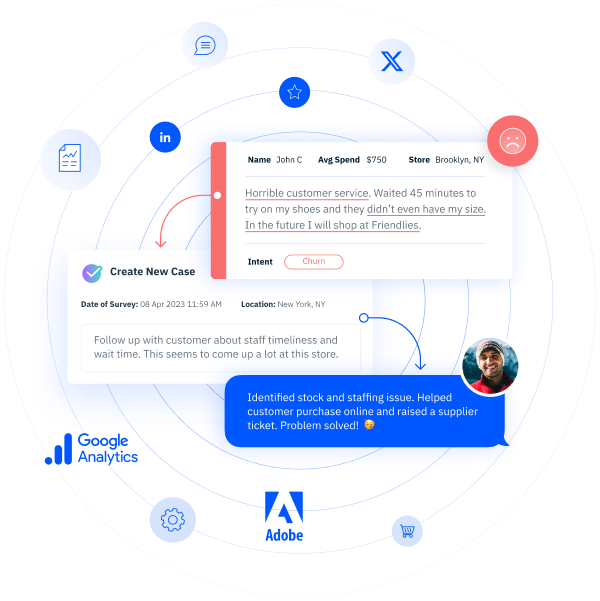
InMoment’s advanced analytics can generate all the associated comments and details about an issue, where it’s happening, the words and themes most commonly associated with it, how widespread it is, what impact it has on your business, and more. It can also generate actionable alerts so you can closely monitor problems that arise—and take action. 

Step #3: Strategize for the Future

With so much data to manage, businesses often forget the potential for feedback to predict customer concerns and behavior. These predictions allow brands to execute dynamic offers, personalized incentives, and customer-focused policies that build loyalty and drive new business. By utilizing your customer journey analytics to predict future problem points and subsequently implement an effective strategy, your company can proactively meet customers’ needs.

Predictive models work the best when they forecast risks and opportunities, including churn/attrition, revenue, customer segments, likelihood to return/recommend, and potential cross-sell and upsell opportunities. With these forecasts, your brand can maintain an informed and preemptive action plan that will keep customers loyal. Customer journey analytics are not only useful today, but for making business improvements in the long run!


You’ve just learned a bit about how to leverage customer journey analytics in your CX Program—but if you’re looking for a more in depth guide to understanding and predicting customers’ needs, read our eBook!
Prove ROI

Every brand wants to crack the code to prove a skyrocketing customer experience (CX) return on investment (ROI). But obtaining stellar ROI is not a simple process, especially if businesses can easily become discouraged when it seems as if their CX programs aren’t producing the amazing results they expected. That’s why some consider it the “holy  grail” of customer experience! But proving the value of your CX program shouldn’t be a process that starts only after the work is done; to successfully show the value of your efforts, you need to consider how you plan to prove ROI from the very beginning. 

Additionally, it’s important to first recognize that the factors impacting ROI cannot be understood linearly. Every department within your company has a different perspective on how their area of the business affects ROI. This makes measuring ROI by customer experience not so straightforward. Your business needs a holistic view of your brand, customers, employees, and the market to drive ROI successfully. 

Here are three tips based on our eBook, “Five Steps to an ROI-Focused CX Program,” that will help your company build a CX program that directly increases revenue. Let’s get right into it!

  1. Design with the End in Mind
  2. Understand Your Customer
  3. Tailor Employee Behavior

Tip #1: Design with the End in Mind

Designing an experience for customers means not just meeting the present need, but the future one as well. This means optimizing the customer journey by adapting to what customers want—even if your business had never considered those ideas before. 

Your company needs to be ready to remove from, add to, and revise its CX program overtime. For example, our eBook 2021 Digital Customer Experience Trends Report, discusses how digital has been a trend in America and Canada long before the pandemic. The main point is that digital will stay relevant after the government removes restrictions, so businesses need to prepare for the future of digital customer journeys. 

As you already know, your CX program is a powerful tool. When your brand designs with careful attention to the intelligence informing you of incoming issues in the customer experience, your chances of increasing ROI improve immensely. In fact, one study found that a focus on the buyer’s journey reaps over 50 percent greater return on marketing investments than those that don’t. 

Tip #2: Understand Your Customer

Actionable intelligence stems from all kinds of sources and each type of data can contribute to your company’s overall knowledge of your customers. From CRM, to VoC, to loyalty, financial, transactional, and beyond, don’t underestimate the value of tons and tons of diverse information. 

By taking advantage of various data channels, Hawaiian Airlines was able to gain a deeper insight into their customers’ experiences. “InMoment appends upwards of 300 customer-specific data points to each response. As a result, Hawaiian Airlines understands the impact that seat location, aircraft type, departure time, delays, food, flight crew, stops, travel history, and other variables play in each customer experience. This extremely detailed analysis enables Hawaiian Airlines to understand trends and pinpoint the exact factors most likely to have significant impacts on customer satisfaction.”

The combination of CX, market experience (MX), and employee experience (EX) data gave Hawaiian Airlines the holistic viewpoint it needed to direct its CX Program towards greater business outcomes. And that’s the key! The right data can be a customer experience game changer and lead to better business performance.

Tip #3: Tailor Employee Behavior 

Now that your brand knows its customers, it can train employees to accommodate them according to their specific needs. Employees are often the most crucial contact point with a customer because they act as company representatives. What customer would stay loyal to your brand or purchase anything if they encounter an employee who fails to meet their standards?

This case study shows that there was a growth in NPS when the business conducted behavioral initiatives instead of primarily focusing on operational improvements. The data tells the truth! By involving employees your brand learns not only about the employee experience but the customer experience through their lens. When both business and employees work in tandem your CX program reaches a higher potential to increase ROI.

We just explained three tips to capture more revenue through customer experience, but there’s more! Read this eBook that goes over five essential steps on how to focus your CX Program on ROI.

Employee Experience

In a post-COVID landscape, businesses across the board have struggled to adapt to evolving customer expectations and, therefore, to keep their focus on a customer experience culture. Some have adapted brilliantly, like Foodstuffs and New Zealand Post. Others, not so much.

Looking to the future, we know there is a certain level of change we can expect, and many of these are outside of everyone’s control. Sometimes, this will involve macro factors like economics, politics, or market trends, and sometimes change will involve micro factors like the demands from a new customer segment or employee health and wellbeing. If brands don’t respond to these factors, chances are, they will disappear.

While there are many things we can’t change, there are two things necessary for a customer experience culture that brands can control:

  1.  Establish loyal raving customers
  2.  Make sure your employees are highly engaged 

This blog is all about the second factor within our control: making sure your employees are switched on and delivering excellent customer service. We know this will in turn affect revenue, retention, and growth.

According to Diane Gherson, head of HR at IBM, employee engagement drives two-thirds of her company’s client experience scores. That proves what Gherson and her team knew intuitively: If employees feel good about IBM, clients do, too.

Transforming Employee Culture: The Wrong Way

InMoment’s Thomas Lorenzo, Sales Director of New Zealand, tells us his point of view on transforming employee culture to be customer-centric. 

Did you know that employee engagement has more of a connection with customer satisfaction than sleeping pills have on reducing insomnia? It’s true:

SLEEPING PILLS & IMPROVEMENT IN INSOMNIA: R = .30

EMPLOYEE ENGAGEMENT & CUSTOMER SATISFACTION:R = .43 ¹

Many businesses make the mistake of relying on external data alone to inform their decisions, which trickles down into employee culture. You might know of a brand who is always trying to match what competitors are doing, digging into market data to solve business challenges, and ultimately looking outside the business for the answers. 

While these factors definitely have a place, relying on this external data alone isn’t the only way to inform your business decisions. By doing so, your employees are likely to feel disengaged and unmotivated. If employees are not brought along the journey, this could lead to big problems for culture. 

So, What is the Right Way To Transform Employee Culture?

The answer to an engaged workforce is to use a combination of data and employee listening. Employees are the lifeblood of your business; therefore, it’s essential to ensure their experiences receive as much attention as customer experiences. To get the most out of your employees, you need to understand their needs and desires including purpose, growth, and satisfaction. Employee feedback is an important part of the data puzzle, and it’s essential to delivering excellent customer experiences.

The data around employee engagement and its impact on revenue has been growing. The Harvard Business Review reported that 71 percent of businesses surveyed ranked employee engagement as “very important” in achieving overall organisational success. Additionally, companies with high employee engagement scores have twice the customer loyalty of companies with average employee engagement levels. 

These results reinforce that the success of employee engagement is measured not just by satisfaction scores, but also employee desire to provide a better experience. Employees are people, and people have an innate desire to engage in meaningful activities. It’s no surprise that employees who are invested in the experience of their individual customers not only create a better experience, but engender loyal brand advocates

Paying Attention to Listening Posts and Taking Action

Listening to market, customer, and employee data together is the best way to make informed decisions in an ever-changing business landscape. All of these play an important role in informing the complete picture of the customer and employee journey with your business, and highlight points in the journey that need to be improved or innovated to stay competitive.

Customer Experience Culture Begins with Employees

To learn more about transforming employee culture which in turn changes the employee experience for the better, we recommend that you take a look at this paper “Better CX Begins with Employees”.

Unstructured Customer Feedback

It’s no secret that businesses need unstructured customer feedback to have a successful customer experience (CX) program. Without honest, detailed criticism or praise, it’s hard to assess how well a product or service is doing, but it’s also difficult to understand the “why” and take action to improve. That’s why more and more, customers are seeing open-ended questions in surveys instead of metric-based ones: unstructured feedback can lead to a more authentic insight into the customer experience.

But how should brands harness the power of unstructured feedback in their existing surveys? And how can they take the next step of not only collecting that feedback, but derive actionable intelligence from it so they can improve experiences? Our latest eBook, “Unstructured CustomerFeedback: The Key to Unlocking the True Voice of Customer,” walks you through best practices we’ve learned from our many years of experience. This blog will spell out the major benefits of employing those best practices. Let’s get started!

Three Ways Unstructured Customer Feedback Improves Experiences

  1. Gathers More Genuine and Less Filtered Responses
  2. Collects the Missing Pieces
  3. Follows the Right Patterns

Benefit #1: Gathers More Genuine and Less Filtered Responses

What makes for a “good” survey? Businesses often make the mistake of only asking metric-based questions, which prompt customers to answer very specific questions in very specific ways. This leaves brands only learning what they want to learn and possibly missing other important aspects of the customer experience.

Let’s say a restaurant uses an NPS question to gauge the success of their customer experiences. The brand’s post transaction survey therefore reads, “on a scale of 1-10 how much would you recommend us?” Customers then respond with only a single number and the restaurant is left wondering why customers rate it as low as a 5. As you can see, this metric-based question can only measure the experience, and therefore fails to explain why a customer would or wouldn’t recommend the eatery. 

If the restaurant had followed up the first question with an open-ended “why” question, then its feedback would include the reasoning behind the score, and would help the business understand what it needs to do to improve the CX program. With open-ended questions, brands hear the voice of customer more clearly because customers have more freedom to candidly express themselves, telling your brand what they actually want to tell you, not what you want to hear.

Benefit #2: Collects the Missing Pieces

Open-ended questions mean unpredictable and varied responses, but that’s a good thing! The feedback you receive is so much more detailed, so it can answer questions and address issues your brand wouldn’t have considered in the first place.

One of our clients, a large hotel and entertainment brand, couldn’t figure out why one of its locations was receiving such low scores from guests. This is because it was using a metric that could only see that guests were unsatisfied with their stay, but not exactly why. Through text analytics, the brand was able to analyze its unstructured data and discover that an air filtration problem was allowing smoke from the casino to enter the rooms.

By leaving survey questions open-ended, your brand not only learns the genuine opinion of customers, but also about problems it might have never known about. At the same time, feedback is not always negative; it’s important for your business to know how well it’s executing at certain touchpoints along the customer journey! These game changing pieces of intelligence can help to fill in the blanks so you have a truly holistic view of the customer experience.

Benefit #3: Follows the Right Patterns 

Listening to the true voice of customer gives your business a greater capability to track common problems your customers are having over time. Your brand will then be able to identify and analyze patterns that emerge from responses and address those issues with an actionable plan.

For instance, let’s imagine that customers are having complications with your company’s website. A recent system update has caused a bug that’s disrupting functionability, leading to a seemingly random rise in customer frustration. With unstructured feedback, your brand would be able to recognize a new trend in responses, spot the platform issue, and take action to fix it. 

Unstructured responses make it easier to recognize both positive and negative trends in your CX program, and also helps you to pinpoint new areas to focus on as customer expectations develop over time. 

In the end, failure to employ unstructured feedback means that your CX program will have a hard time realizing its potential. Metrics alone can only measure the past; they can’t help you take action and create better experiences in the future. That’s why the stories you derive from open-ended questions are so vital to your big picture success—and to your bottomline.

 
Unstructured customer feedback can help your business improve customer experiences by unlocking the true Voice of Customer—but how do you best leverage that feedback in your program strategy? Read our latest eBook to read about the best practices recommended by our experts here!

customer journey mapping

If you’re in charge of customer experience (CX) at your organisation, you’ll know how important it is to take a walk in your customers’ shoes. But, do you know the true impact of visualising customer interactions? Brands who understand their customers’ journey stand out in the marketplace. InMoment’s global research found that organisations who have developed their customer journey map and understand experiences across these journeys reach the highest level of customer experience maturity. And, mature programs are aligned with outstanding business results. 

Mature businesses experience: 

  • 93% more profitability
  • 92% higher NPS scores
  • 89% greater retention

At InMoment, we believe experiences—the culmination of moments filled with emotions, judgments, learnings, and much, much more—shape the world we live in. And with every moment, there is an opportunity to make a positive impact; to leave a mark. 

What is Customer Journey Mapping?

When you look at the world through your customers’ eyes, you’ve started along a process called “customer journey mapping.” This process involves walking in the shoes of a typical customer as they discover your brand, interact with your products, and services, and decide if they’ll stay or switch to your competitor. Along their journey, there will be multiple opportunities to engage with them and deliver exceptional experiences. It’s time to understand—and own—the moments that matter to your customer.

Why Does Customer Journey Mapping Matter?

Customer journey mapping is a proven way to understand why people do what they do and what emotions drive them. With a customer journey framework, your business can take informed action to solve problems, provide a truly differentiated experience, and drive value for your customers, employees and business. 

How Can I Get My Hands on a Customer Journey Map Template?

Customer Journey Mapping is a flexible consulting engagement for organisations seeking more complete, accurate insights into what their customers really feel, perceive, and experience. It includes resources, expertise, and documentation—including detailed visual representations of the complete customer journey—to identify hidden moments that matter, and close the gap between internal CX perceptions and customer realities. At InMoment, we have in-house consultants who take on the challenge with you. 

Interested in learning more about customer journey mapping? This eBook “Five Steps to Uncovering the Real Customer Experience Journey,” breaks down the strategies you need to build, act on, and evolve your customer journey map. Read it here!

Customer Experience Metrics

When it comes to customer experience (CX), a single moment can mean all the difference. And that can be easy to forget when your brand is interacting with countless customers over multiple channels every day. When it comes down to it, however, a moment can mean the difference between a positive or a negative experience—and a boost or a dent in your core customer experience metrics.

For many experience programs, those metrics are the end-all-be-all. Every move they make is with the express purpose of driving those numbers up. At InMoment, we believe that experience leaders should aim higher at goals that go above and beyond typical customer experience metrics. More specifically, we help our clients design programs that target four economic pillars to help them not only improve experiences for customers, boost metrics, and build loyalty, but also to benefit the business where it counts: the bottom line.

Today, we’ll walk you through each of those four pillars and tell the stories of brands who have leveraged their experience programs to achieve those goals. Let’s get to work!

The Four Economic Pillars of CX

  1. Customer Acquisition
  2. Customer Retention
  3. Cross Sell & Upsell
  4. Cost Reduction

Pillar #1: Customer Acquisition

A well-built CX program enables organizations to anticipate what new customers are looking for in a brand—and therefore they’ll be able to leverage that information in their efforts to boost acquisition numbers.

For example, a major athletic company sought to capitalize on acquisitions by optimizing its surveys to find new types of customers. By targeting respondents between the ages of 18 and 35 with specific questions, the company was able understand this demographic and expand to new cities and demographics. 

The practitioners who ran this initiative were able to prove its worth by tracking the new customer acquisition, increases in unique customers, and market share growth that it generated.

Pillar #2: Customer Retention

Organizations should never underestimate the power of service recovery—70 percent of customers who have a situation resolved in their favor will return to a brand, while a 10 percent increase in customer retention can grow a company’s value by 30 percent. Truly customer-centric companies leverage their CX programs to identify disgruntled customers, reach out to close the loop with them, and ultimately prevent customer churn.

For example, America’s largest cable and home internet provider leverages VoC technology in their regional customer care centers. They discovered that 3% of all respondents requested callbacks, totaling 1,000 customer recovery opportunities a month (or a whopping 12,000 per year). By combining this insight with customer lifetime value, the company was able to identify $23 million in recoverable revenue—directly resulting from customer retention!    

Pillar #3: Cross-Selling/ Upselling

Given that it costs 25 times more to acquire a new customer than to retain an existing one, brands stand to gain a lot from finding new cross-selling and upselling opportunities.

Organizations can leverage CX listening tools to identify what about a brand spurs trust and loyalty from its customers and then take action to make those offerings even stronger. After all, nearly 50 percent of customers are willing to spend anywhere from 11 to 50 percent more with a brand they feel they can trust. Additionally, predictive analytics can be tuned to identify which customer segments are more open to new offerings. This allows marketing teams to target those customers with campaigns that will encourage them to spend more with the brand.

An example of a brand leveraging their experience program to grow share of wallet comes from a large cafe group that was able to capture feedback from its existing customer base, analyze their sentiments, and make fundamental menu changes accordingly. As a result, the cafe group saw a noticeable revenue bump that it was able to link directly to their program insights and subsequent menu changes.

Pillar #4: Cost Reduction/ Elimination

Finally, organizations can use CX feedback and employee feedback to both save money within operations and to simplify their provided experience. Are there ineffective processes that are costing more than they’re worth? Eliminating such costs can save companies time, resources, and revenue. (After all, training one employee can cost an average of almost $1,100!)

A top-tier mattress retailer used CX tools to install an exit survey for departing employees, giving them a greater understanding of employee sentiment. After implementing the necessary changes to reduce turnover and new hire training costs, the company was able to establish a clear link between its CX strategy and the ROI it helped to generate.

Don’t Stop at Customer Experience Metrics

In the simplest of terms, what we do as CX professionals is create interactions that inspire attitudes in our customers than, in turn, produce desired outcomes. One of your desired outcomes can be to simply improve your CX metrics, but don’t let your goals stop at the numbers! 

Instead, create a strategy for your experience program that aims to benefit the business as a whole by increasing customer acquisition and retention, growing wallet share, and decreasing unnecessary costs. You have the power to help your business thrive, so aim big, go beyond the metrics, and inspire meaningful outcomes!


Want to learn more about how your experience program can produce desired outcomes? Check out this eBook that explains how to use the power of social science and your experience ecosystem to leverage the power of a single moment and meet your goals.

Linkage Analysis

Linkage analysis is a key part of any customer experience (CX) program. It’s a process that allows companies to dig deep into the experiences they provide to ask the big CX questions: what could the business do better, what are customers seeing, what is impacting finances, and how to create and sustain true Experience Improvement (XI).

Today, we’re going to run through three elements we’ve seen companies use to create amazing linkage analysis strategies, enabling practitioners like you to meaningfully improve customers’ experiences, create a strong bottom line, and point back to all of this when going back for more funding!

Three Elements of Successful Linkage Analysis Strategies

  1. Business Insights
  2. Customer-Specific Details
  3. What If” Scenarios

Key #1: Business Insights

Business insights are one of customer relationships’ biggest building blocks. Diving into this element of your CX program empowers your team to better understand the relationship between retention, loyalty, and profitability. Once you’ve got that intel handy, your program’s ties to overall business wins and drivers become clear as day! Such drivers might include how customer experience relates to loyalty, how business ops are affecting retention, and the financial impact that comes with Experience Improvement. That last one is especially important for proving ROI and making the case for the positive impact your program has on customer relationships!

Key #2: Customer-Specific Details

While on the subject of customers, let’s get into how linkage analysis can cover details unique to the people who keep your brand trucking. Specifically, you want to look at the mechanics of specific transactions and behaviors. How intuitive is your contact center menu? Can customers jump between channels en route to getting a single issue resolved? How effective does your customer service have to be for your organization to maintain its market position, and how far might you rise if that service was improved? Questions like these vary from brand to brand, but knowing the answers makes all the difference.

Key #3: “What If” Scenarios

Our third and final tip for making linkage analysis valuable to your company is integrating it into as many simulations as possible. Organizational success comes from future-proofing your experience, which means knowing about customer preferences and potential obstacles before they even fully form. This foresight is where linkage analysis can be very useful, because brands can use it to envision, say, the revenue that could be gained by shortening the claims process, or the retention boost from a more engaged workforce.

The Next Step

CX programs can get a big boost from applying linkage analysis toward these ends, but how else might linkage analysis boost Experience Improvement? Click here to read our full report on everything linkage analysis can do for your brand, your customer relationships, and your bottom line!

We all have that friend in our network crushing it at that hot startup. The comp plan is amazing, 8 of 10 reps are already at quota, the incentive triggers are kicking in. The product rocks, marketing delivers leads from everywhere and the VP of Sales can be overheard bragging about his reps commission checks.  If you have that story in your network there is one thing for sure; that company’s net promoter score (NPS) is way above average, and the trend line probably looks similar to Amazon’s stock price.

Dwight Office How do I know this? When product, marketing, sales and customer success are aligned it is the foundation for a company to sustain high growth.  This model for success often results in a high NPS.

So why should you care about your company’s NPS?  Most reps probably don’t know much about this metric. It’s probably as foreign as the rate you pay the 401k service provider to invest your money, but in the same way it can control your fate more than you know.

Jack I really don't care

What is NPS?

Net Promoter Score is the customer loyalty metric used by over 70% of Fortune 500 companies for its ability to predict retention and growth. It starts by asking customers a single question…

NPS Survey

 ……followed by an opportunity for open-ended feedback:

NPS Survey Feedback

Customers are classified into three groups based on their answers:

  • Promoters (9-10)are loyal customers and a great source of referrals
  • Passive (7-8)  customers are satisfied with the service but are susceptible to competitors.
  • Detractors (0-6) are unhappy customers and may churn.

The score is calculated this way:

NPS = % Promoters – % Detractors

4 Ways NPS impacts Sales

1. Retention/Renewal  

If you are in a farmer/hunter role you rely on some level of renewal to hit quota.  With NPS, both the score and qualitative (customer comments) can provide you the ultimate looking glass self.  Ask Geoffrey James from Inc. Magazine about self-awareness being a top 5 trait in a great sales rep. In other words, how you perceive your capabilities, and how you get along with your peers.  Ultimately, you need to be aware of how your clients perceive your brand and products.  NPS data allows you to peek into the customer’s mind about their experience & journey with your company. You can integrate these perceptions & insights into your own narrative within the sales pitch.

2. Comp Plan

Your CRO is a lot more concerned when customer churn is high.  Which in turns means his VP and your sales manager are breathing down your neck and asking for the forecast every 5 minutes.  I’ve been in sales orgs where previous success inflates the upcoming comp plan and sets unrealistic expectations.  There could be a feature or product that is over-promising & under-delivering which creates a lagging effect as sales and customer success deal with the fall out, yet bookings are still strong on paper and have not yet caught up.

A misaligned comp plan that doesn’t represent current customer sentiment and propensity to buy is kind of like a watching a bad movie sequel.  At the time it seems like a good idea, the first movie was amazing- but as you see the upcoming trailer you know something is different. You call up your friends and see the movie anyway to try and recapture the original experience. Afterwards you feel short-changed and wonder why you didn’t speak up & suggest a different movie or activity all together.

Once a comp plan is in motion, it’s hard to stop. If customers are not buying or renewing because the price is too high or the feature that was promised is not delivering, this is your chance to speak up.  Speaking with the voice of the customer by leveraging NPS data and citing real customer concerns will give you credibility.  You only have a few times a year during the all hands or sales kick-off when the comp plan is rolled out to speak up, why not use your own customer data to present any concerns? 

3. Upsell

A score of 9 or 10 means your clients would recommend you to a friend or colleague.  At the very least that means they will do a review for you on G2 Crowd or the app store.  If they really like you they might actually recommend you within their network. Make a list of the promoters and set up an action plan. It could be an executive call back program; where you work with your manager to reach out to all the Enterprise Client promoters and ask for 15 minutes meetings with each over the next quarter. Design a plan to give them something in return for asking for the referral. This could be access to the product roadmap, discounts etc. For large enterprise clients have your CRO or CEO call them.  What client doesn’t want to feel valued by an executive?

4. Career Path

As mentioned in the open, a rising NPS score can lift your sales career. Knowing what your score is today and historically over the last 12 months is invaluable to your success. If your company’s score dropped 12 points, try to determine why.   If the score is declining or already low, something is misaligned. If you are looking at negative employee reviews on GlassDoor and wondering what happened to your company, it’s already too late. NPS can be the leading indicator of what may happen in the future to your company and role.

Be the Hero: Find your NPS Data  

Superman Hero

Set up time with your VP of Customer Success or Customer Insights person. If you work for a larger organization ask your manager to help coordinate a meeting. This person is probably running an email campaign for NPS and will have a file of the data.  They can walk you through the current score, historical data and help you find the customer comments. Finally, ask them what the reporting cadence is.  If they are running it quarterly or bi-annually, it’s not enough. NPS data should be gathered as close to real-time as possible so you have a constant pulse of customer perceptions.  You really might be amazed at what you can learn from your own customers feedback. 

Get IN(credible) with NPS

Another use of NPS is to strengthen your pitch deck. Add a page to the deck that touts your score or your upward trend. Be sure to include some customer verbatims from the qualitative feedback– that kind of authenticity is persuasive. 

Every company says “we put customers first. ” When you include some aspect of your NPS story in your pitch, you prove it.

Start measuring Net Promoter Score for free with InMoment

This week we are featuring a guest author, Peter Poer, Head of Business Development & Content at test-prep platform Magoosh. We love the creative, agile way the Magoosh team used NPS as the A/B test metric to improve their product (and student happiness.) 

Magoosh is all about making sure our students are well educated and happy.  But we’re also a data-driven business that uses metrics to make decisions — vague notions of happiness are nice, but we want numbers!

So this is the story of how we improved student happiness by A/B testing changes to our product with the goal not of optimizing clicks or conversions or revenues, but of maximizing student happiness.   To start, though, I’ll introduce the metric at hand: Net Promoter Score.

NPS: Our Reliable Referral Indicator

Net Promoter Score is a metric that tells you, on the whole, how willing your customers are to promote your product.  Customers are asked on a scale of 1-10 how likely they would be to recommend your product; 9s and 10s are considered “promoters”, 7s and 8s are neutral, and anything below 6 is a “detractor.”  Your Net Promoter Score is calculated by subtracting the number of detractors from the number of promoters and dividing by the total number of respondents.  As a result, NPS is a percentage somewhere in the range of -100% (all detractors) to 100% (all promoters).  Not to brag, but our NPS is high. Really high.

At Magoosh, NPS is one of the most important metrics we track — it helps us determine not only whether students like our customer service and user interface, but also how well our products prepare students for their exams.  And most importantly it has been a reliable leading indicator of growth in word-of-mouth referrals — our largest marketing channel.  When NPS is high, students talk about Magoosh and more people buy it!

Screen Shot 2015-06-03 at 4.13.43 PM

Historically, we’ve asked students the NPS question after they’ve taken their exams (and, importantly, seen their final scores).  We do this because our products prepare students for tests, and, really, the proof is in the pudding.  You can’t fully decide if you’re willing to recommend Magoosh for GRE prep until you’ve taken the real GRE.  The downside is that it can take a while for us to see NPS change in response to product changes.  Since we’re waiting until after students are done studying to survey them, it can take months between when a student sees a new feature and when she rates our product.

Our NPS Issue: Mismatched Expectations

Because NPS is such an important metric to our company, we take changes very seriously.  Earlier this year we saw NPS for our GMAT product dip fairly significantly.  Looking into why, we discovered that several passive and detractor students were complaining that they were getting lower scores on their real GMAT than they did on their Magoosh practice tests.

Screen Shot 2015-06-03 at 2.31.45 PM

Our algorithm was telling students to expect one score, but, for some, their official reports were coming back lower — obviously a frustrating experience.  These students were still improving their scores significantly, but once you’ve got a 750 in your mind, a 700 seems disappointing!  We determined that we needed to fix our score prediction algorithm to be more accurate, but we were left with a major concern: would an improved algorithm that displayed a lower predicted score be demoralizing for students?  Which was worse for customer satisfaction — a lower predicted score while studying, or a disappointing final score after the exam?

The Challenge: Could we optimize quickly for NPS?

Normally when we have questions about what works best for conversion or marketing, we run a quick A/B test to determine what works best.  But NPS was different — we’d never A/B tested for NPS optimization before, and our NPS collection survey only went to students after their exams.  It would be months before students who saw the changed algorithm took their exams and we got back NPS data.  Making a significant change without knowing how it would affect our word of mouth marketing was a big risk.

Our Solution:  Bring NPS inside our product

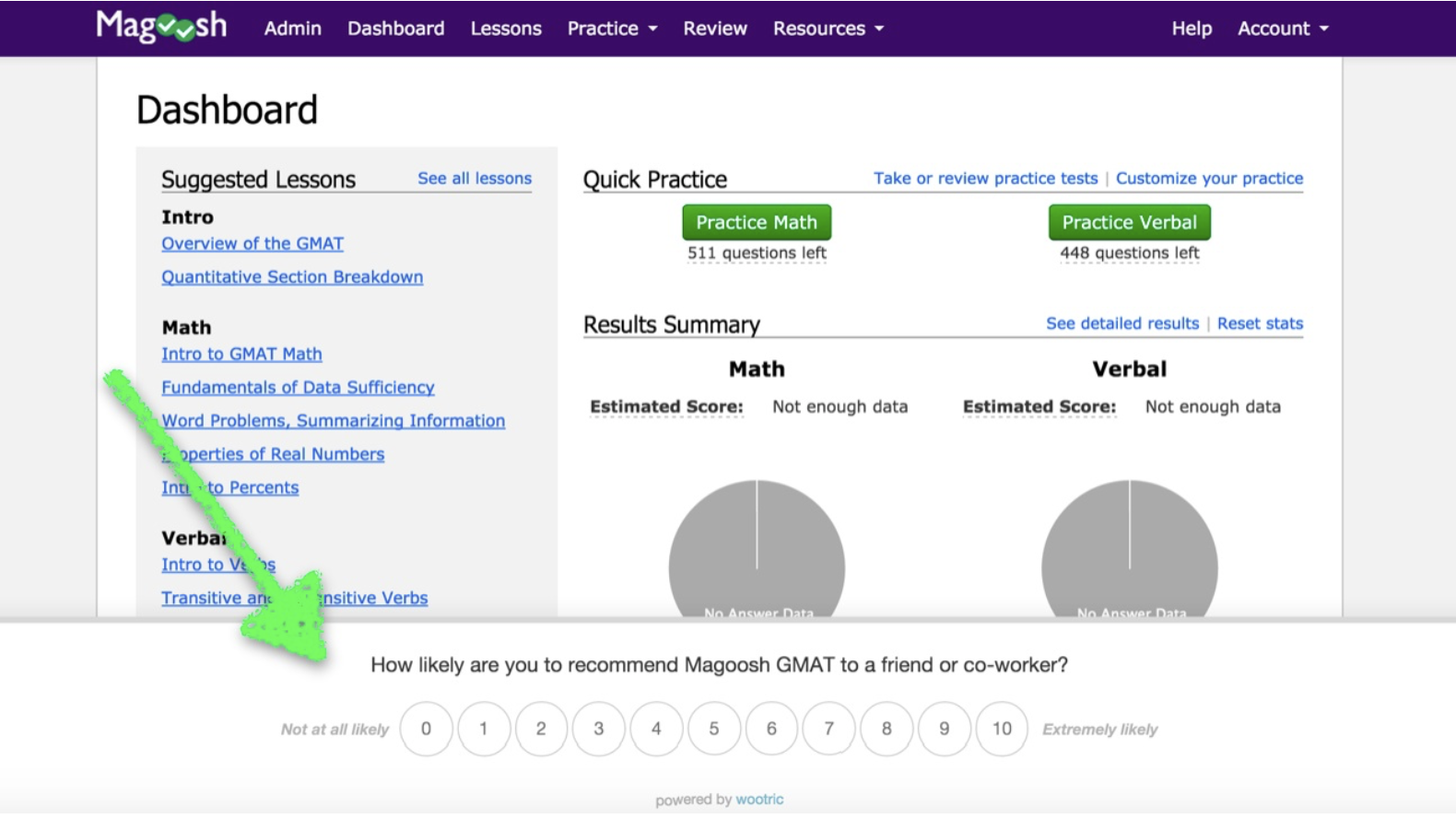
We determined that in order to A/B test the algorithm change, we needed a method for collecting NPS data while students were still studying — not just waiting til the end of their exam.  We began using a third-party tool called InMoment, which allows us to ask the NPS question in our product and analyze the data in real-time.  We then deployed the changed algorithm to half of our GMAT students, and we could then match the “Likely-to-refer” rating to students in the treatment and control groups.  Suddenly NPS had a new use case for us — as a powerful, agile product tool.

Wootric NPS Survey in Magoosh Dashboard


It turned out that the improved algorithm did not affect student satisfaction while studying with Magoosh — NPS from both student groups was identical.  Knowing this allowed us to roll the change out to all students more quickly.  We were also able to track the students in the A/B test over time, and have seen that post-exam NPS for students in the treatment group is a full nine points higher than for the control.

Takeaways from A/B Testing for NPS

1)  Include current customers in your optimizable funnel

Our goal is always to provide our students with the best possible test prep experience.  But since we’re not able to read minds, it’s not always easy to know if what we’re doing is actually providing a great experience.  It’s easy to think of customer acquisition as a funnel, and to wrap our brains around how to A/B test to optimize that funnel.  But what doesn’t come easily (at least for most startups — and definitely not for Magoosh, at first) is to think of current customers as part of an optimizable funnel too.

2)  Optimize your products for referrals

If your business is built on recommendations and word-of-mouth, then you really can’t afford not to optimize your products for referrals.  This process has helped us make sure that what we’re doing is making a meaningful difference for students, and has provided us with a useful and repeatable framework for testing future features and products.

3)  Focus on agility

Shift your thinking on NPS from a one-time transactional model to an ongoing and contextual model.  In-product NPS tools available today like Wootric can help you do this easily, as well as keep track of your A/B test groups.  You can speed up decision making and keep your pulse on customer happiness.

Fee in-app NPS with Wootric

Change Region

Selecting a different region will change the language and content of inmoment.com

North America
United States/Canada (English)
Europe
DACH (Deutsch) United Kingdom (English)
Asia Pacific
Australia (English) New Zealand (English) Asia (English)